Honey Garlic Salmon Recipe | Easy Baked Salmon Dinner
Honey garlic salmon is the perfect weeknight dinner that looks and tastes like something from a fancy restaurant but comes together in just 20 minutes. This elegant dish features perfectly cooked, flaky salmon fillets coated in a sweet, savory, and slightly tangy glaze made with honey, garlic, and soy sauce. The combination of flavors is absolutely addictive - the sweetness of honey balances the saltiness of soy sauce, while fresh garlic adds aromatic depth that makes this dish irresistible.
What makes honey garlic salmon so popular? It's the trifecta of quick, healthy, and delicious. Salmon is one of the healthiest proteins you can eat, packed with omega-3 fatty acids, high-quality protein, and essential vitamins. Yet despite its nutritional benefits, it tastes indulgent and luxurious when prepared with this flavor-packed glaze. The caramelization that happens during cooking creates a beautiful golden crust on top while keeping the salmon moist and tender inside.
This recipe is also incredibly versatile and forgiving. Whether you're cooking for a special occasion, meal prepping for the week, or just want a quick dinner that doesn't taste rushed, honey garlic salmon delivers. It pairs beautifully with almost any side dish - rice, quinoa, roasted vegetables, salad - making it adaptable to any meal plan. Plus, salmon cooks quickly and evenly, so there's minimal risk of overcooking if you follow the timing.
This foolproof recipe delivers perfectly cooked salmon with a glossy, caramelized honey garlic glaze that's neither too sweet nor too salty. You'll learn the secrets to choosing the right salmon, achieving the perfect flaky texture, creating a glaze that's perfectly balanced, and timing everything so your salmon is never dry. Let's make the best honey garlic salmon you've ever tasted!
Prep Time: 5 minutes
Cook Time: 12-15 minutes
Total Time: 20 minutes
Serves: 4
Difficulty: Easy
Cuisine: Asian-Inspired, American
Diet: Gluten-free (with substitutions), Keto-friendly, Low-carb
High-Protein: 34g per serving
Omega-3 Rich: Heart-healthy meal
Quick Weeknight Dinner: Ready in 20 minutes!
Ingredients
For the Salmon:
4 salmon fillets (6 ounces each), skin-on or skinless
1 tablespoon olive oil
1/2 teaspoon salt
1/4 teaspoon black pepper
Optional: Lemon wedges for serving
For the Honey Garlic Glaze:
1/3 cup honey
3 tablespoons soy sauce (use tamari for gluten-free)
3 tablespoons water
4 garlic cloves, minced (about 1 1/2 tablespoons)
1 tablespoon fresh lemon juice
1 teaspoon fresh ginger, minced (optional but recommended)
1/4 teaspoon red pepper flakes (optional, for heat)
1 tablespoon cornstarch mixed with 1 tablespoon cold water (slurry, for thickening)
For Garnish:
Sesame seeds (white or black)
Sliced green onions
Fresh parsley or cilantro
Extra lemon wedges
Optional Vegetables (to bake alongside):
2 cups broccoli florets
1 pound asparagus, trimmed
2 cups green beans
Bell peppers, sliced
Cherry tomatoes
How to Make Honey Garlic Salmon
Instructions:
Step 1: Prepare the Salmon
Choose quality salmon: Look for fresh, wild-caught salmon if possible - it has better flavor and texture than farmed. The flesh should be bright, firm, and smell fresh (like the ocean, not fishy). Common varieties: Atlantic salmon (milder, fattier), King/Chinook salmon (richest, most flavorful), Sockeye salmon (deep color, firm), or Coho salmon (medium flavor). All work beautifully with honey garlic glaze!
Bring to room temperature: Remove salmon from the refrigerator 15-20 minutes before cooking. Room temperature salmon cooks more evenly than cold salmon straight from the fridge. This prevents the exterior from overcooking while the center remains cold.
Pat completely dry: Use paper towels to thoroughly pat the salmon fillets dry on all sides. This is crucial! Moisture prevents browning and caramelization. A dry surface creates that beautiful golden crust.
Check for pin bones: Run your fingers along the center of each fillet. If you feel any small bones (pin bones), remove them with clean tweezers or needle-nose pliers. Pull gently in the direction the bone is pointing.
Season the salmon: Brush or drizzle each fillet with olive oil on all sides. Season both sides with salt and black pepper. The oil helps the glaze adhere and promotes browning. Pro tip: Don't over-season with salt since the soy sauce in the glaze is salty - just a light sprinkle!
Step 2: Make the Honey Garlic Glaze
Combine glaze ingredients: In a small saucepan over medium heat, combine honey, soy sauce, water, minced garlic, lemon juice, minced ginger (if using), and red pepper flakes (if using). Whisk together until well combined and smooth.
Bring to a gentle simmer: Heat the mixture, stirring occasionally, until it comes to a gentle simmer (small bubbles breaking the surface). Reduce heat to medium-low and let it simmer for 2-3 minutes. The garlic should become fragrant and mellow slightly. Don't boil vigorously or the honey can burn.
Thicken the glaze: In a small cup, mix 1 tablespoon cornstarch with 1 tablespoon cold water until smooth with no lumps. This is called a slurry. Slowly pour the cornstarch slurry into the simmering glaze while whisking constantly. Continue whisking for 1-2 minutes until the glaze thickens to a syrup-like consistency that coats the back of a spoon. Important: The glaze will thicken more as it cools, so don't make it too thick!
Taste and adjust: Remove from heat and taste the glaze. It should be sweet, savory, with garlic and a hint of tang from lemon. Too sweet? Add a splash more soy sauce or lemon juice. Too salty? Add a bit more honey. The glaze should be well-balanced, not one-dimensional.
Set aside: Reserve about half the glaze in a small bowl for serving. You'll use the other half for basting during cooking. Pro tip: Never use glaze that touched raw salmon for serving - always set some aside first!
Step 3: Bake the Salmon (Oven Method - Recommended)
Preheat the oven: Preheat your oven to 400°F (200°C). Position a rack in the center of the oven for even cooking. This temperature is ideal - hot enough to caramelize the glaze but not so hot that the salmon dries out.
Prepare the baking pan: Line a large rimmed baking sheet with parchment paper or aluminum foil for easy cleanup. You can also lightly grease the pan with oil or cooking spray.
Arrange salmon on pan: Place the seasoned salmon fillets on the prepared baking sheet, spacing them at least 2 inches apart. If using skin-on salmon, place them skin-side down. This allows the skin to act as a barrier and keeps the flesh from sticking to the pan.
Add vegetables (optional): If roasting vegetables alongside the salmon, arrange them around the salmon on the same pan. Toss vegetables with a little oil, salt, and pepper first. Good options: broccoli, asparagus, green beans, or cherry tomatoes. They'll roast in the same amount of time!
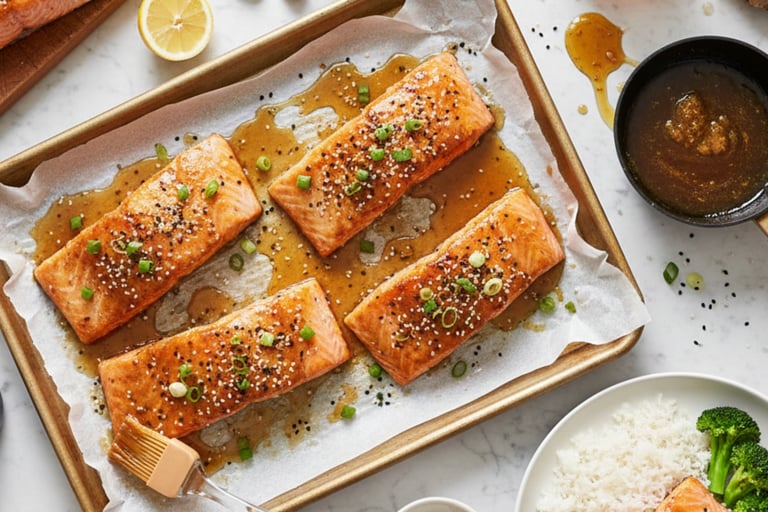
First brush of glaze: Using a pastry brush or spoon, generously brush each salmon fillet with the honey garlic glaze, coating the entire top surface. Reserve remaining glaze for basting.
Bake: Place the baking sheet in the preheated oven. Bake for 10 minutes without opening the oven door.
Baste again: After 10 minutes, carefully remove the pan from the oven. Brush the salmon with another generous layer of glaze. This second application creates that beautiful caramelized coating.
Finish baking: Return to the oven and bake for another 2-5 minutes, depending on thickness. Total cooking time: 12-15 minutes for 1-inch thick fillets. Thinner fillets (3/4 inch) need only 10-12 minutes total. Thicker fillets (1.5 inches) may need 15-18 minutes.
Check for doneness: The salmon is done when it flakes easily with a fork, is opaque throughout, and reaches an internal temperature of 145°F on an instant-read thermometer inserted into the thickest part. Pro tip: Slightly undercooked is better than overcooked! Salmon continues cooking from residual heat after you remove it from the oven. Pull it out when it's 135-140°F in the center, and let it rest - it will reach 145°F perfectly.
Look for visual cues: The salmon should be opaque (not translucent) throughout, with a slightly darker line running through the center that's just turning opaque. The surface should be beautifully caramelized and glazed. White albumin (protein) may appear on the surface - this is normal and harmless!
Step 4: Pan-Sear Method (Alternative - More Caramelization)
Heat the pan: Heat 1 tablespoon olive oil in a large non-stick or cast-iron skillet over medium-high heat until shimmering but not smoking.
Sear salmon: Place salmon fillets in the pan, presentation side down (the side without skin, or the prettier side). Don't move them! Let them sear undisturbed for 4-5 minutes until a golden crust forms.
Flip carefully: Using a wide spatula, gently flip each fillet. Reduce heat to medium.
Add glaze: Brush the cooked top with honey garlic glaze. Cook the second side for 3-4 minutes.
Baste and finish: Brush more glaze on top and cook for another 1-2 minutes until salmon is cooked through. The glaze will caramelize beautifully in the pan!
Rest briefly: Remove from heat and let rest 2-3 minutes before serving.
Step 5: Serve
Plate beautifully: Transfer salmon fillets to serving plates. If you cooked them skin-on, you can serve with the skin (it's delicious and crispy!) or slide a spatula between the flesh and skin to remove it.
Drizzle with reserved glaze: Spoon the reserved clean glaze over each salmon fillet. Don't drown it - you want to see the beautiful caramelized surface!
Garnish generously: Sprinkle with sesame seeds (white, black, or both), sliced green onions, and fresh herbs like parsley or cilantro. Add lemon wedges to the plate for squeezing.
Serve immediately: Salmon is best enjoyed hot and fresh! Serve with your choice of sides: rice, quinoa, roasted vegetables, steamed broccoli, mashed potatoes, or a fresh salad.
Presentation tip: For restaurant-style plating, place a mound of rice or vegetables on the plate first, then lay the glazed salmon on top. Garnish and drizzle with extra glaze. Add a lemon wheel on the side for color!
Variation 2: Spicy Honey Garlic Salmon (Sriracha Kick)
Ingredient Modifications:
Add: 1-2 tablespoons sriracha or hot chili sauce to glaze
Add: 1/2 teaspoon crushed red pepper flakes
Optional: Add 1 teaspoon sesame oil for nutty depth
Garnish: Extra sriracha drizzle and sliced jalapeños
Instructions:
Make glaze as directed, adding sriracha and red pepper flakes with other ingredients.
Taste and adjust heat level - add more sriracha for extra spice.
Cook salmon as directed.
The spicy-sweet combination is incredibly addictive!
Serve with cooling sides like cucumber salad or avocado.
Garnish with extra sriracha drizzle and sliced jalapeños for heat lovers.
Variation 3: Citrus Honey Garlic Salmon (Orange or Lime)
Ingredient Modifications:
Add: Zest of 1 orange or 2 limes
Replace: Lemon juice with fresh orange juice or lime juice
Add: 1 tablespoon rice vinegar for brightness
Optional: 1/4 teaspoon Chinese five-spice powder
Instructions:
Add citrus zest to the glaze for aromatic oil and intense flavor.
Use orange juice for sweet-tangy flavor, or lime juice for brighter, more tart notes.
Add rice vinegar for extra tang.
Cook salmon as directed.
The citrus brightens the glaze and complements salmon beautifully!
Garnish with citrus wheels and fresh cilantro.
Variation 4: Teriyaki-Style Honey Garlic Salmon
Ingredient Modifications:
Add: 1 tablespoon mirin (sweet rice wine)
Add: 1 tablespoon rice vinegar
Add: 1 teaspoon sesame oil
Replace: Part of honey with 1 tablespoon brown sugar
Add: Fresh ginger (increase to 1 tablespoon)
Instructions:
Make glaze with mirin, rice vinegar, and sesame oil for authentic teriyaki flavor.
Use combination of honey and brown sugar for deeper sweetness.
Increase ginger for more pronounced Asian flavors.
Cook salmon as directed.
This teriyaki-inspired version is perfect over rice!
Garnish with sesame seeds and green onions.
Variation 5: Honey Mustard Garlic Salmon
Ingredient Modifications:
Add: 2 tablespoons Dijon mustard
Add: 1 tablespoon whole grain mustard
Reduce: Honey to 1/4 cup (mustard adds tang)
Optional: 1 teaspoon apple cider vinegar
Instructions:
Whisk both mustards into the glaze ingredients.
The mustard adds tangy depth and works beautifully with honey.
Reduce honey slightly since mustard balances the sweetness.
Cook salmon as directed.
This tangy-sweet version is elegant and sophisticated!
Perfect for those who find regular honey glaze too sweet.
Variation 6: Sheet Pan Honey Garlic Salmon with Vegetables
Additional Ingredients:
2 cups broccoli florets
1 pound asparagus, trimmed
1 red bell pepper, cut into strips
1 tablespoon olive oil for vegetables
Salt and pepper to taste
Instructions:
Preheat oven to 400°F.
Toss vegetables with olive oil, salt, and pepper.
Arrange vegetables on a large sheet pan.
Roast vegetables for 5 minutes to give them a head start.
Place seasoned salmon fillets on the pan with vegetables.
Brush salmon with honey garlic glaze.
Roast together for 12-15 minutes, basting salmon once more at 10 minutes.
Everything cooks together - complete meal on one pan!
Perfect for easy cleanup and weeknight dinners.
Chef's Tips & Pro Secrets:
Don't overcook salmon: This is the #1 mistake! Salmon should be just opaque in the center and flake easily. Use an instant-read thermometer and pull it at 135-140°F - it will coast to 145°F as it rests.
Dry the salmon thoroughly: Moisture is the enemy of caramelization. Pat salmon completely dry before cooking for that beautiful golden crust.
Let it rest: Give salmon 2-3 minutes to rest after cooking. This allows juices to redistribute and the carryover heat to finish cooking the center perfectly.
Skin-on vs. skinless: Both work! Skin protects the flesh and adds flavor. If using skin-on, cook skin-side down - the skin acts as a barrier. The skin gets crispy and delicious! If you prefer skinless, that works too.
Choose center-cut fillets: These are the most uniform in thickness, ensuring even cooking. Avoid thin tail pieces which cook too quickly and dry out.
Room temperature matters: Cold salmon from the fridge cooks unevenly. Let it sit at room temp for 15-20 minutes before cooking.
Reserve glaze for serving: Never use glaze that touched raw salmon for serving. Always set aside clean glaze before you start cooking!
Watch for albumin: White protein (albumin) appearing on the surface is normal - it just means proteins are coagulating. It's harmless but can be minimized by not overcooking or cooking at slightly lower heat.
Make extra glaze: The glaze is so good, make extra! It's delicious drizzled over rice, vegetables, or used as a dipping sauce.
Substitute honey: If avoiding refined sugar, use maple syrup or agave nectar instead of honey. The flavor will be slightly different but still delicious.
Scale up easily: This recipe doubles or triples perfectly for meal prep or entertaining. Just use multiple pans or work in batches.
Leftovers are versatile: Use leftover salmon in salads, grain bowls, pasta, or eat cold with rice!
Nutrition Information (Per Serving - 1 fillet):
Calories: 340
Protein: 34g
Carbohydrates: 18g
Fiber: 0g
Sugar: 17g
Fat: 14g
Saturated Fat: 2g
Cholesterol: 85mg
Sodium: 520mg
Potassium: 720mg
Omega-3 Fatty Acids: 2,000mg
Vitamin D: 110% DV
Vitamin B12: 95% DV
Selenium: 85% DV
Health Benefits - Why Salmon is a Superfood:
Salmon is one of the healthiest foods you can eat! It's an exceptional source of high-quality protein (34g per serving) which supports muscle maintenance, tissue repair, and keeps you full for hours. But what makes salmon truly special is its omega-3 fatty acids - each serving provides about 2,000mg of EPA and DHA, the beneficial omega-3s that support heart health, brain function, and reduce inflammation throughout the body.
These omega-3s have been shown to lower blood pressure, reduce triglycerides, decrease risk of heart disease and stroke, support brain health and memory, reduce depression and anxiety symptoms, and fight inflammation that contributes to chronic disease. Salmon is also one of the best dietary sources of vitamin D (110% of daily needs!), which supports bone health, immune function, and mood regulation.
Salmon provides impressive amounts of B vitamins, particularly B12 (95% DV), which supports energy production and nervous system health. It's rich in selenium, a powerful antioxidant that supports thyroid function and protects cells from damage. The astaxanthin (a carotenoid that gives salmon its pink color) is a potent antioxidant with anti-inflammatory properties.
To keep this meal even healthier: use low-sodium soy sauce or tamari to reduce sodium, serve with lots of vegetables for fiber and nutrients, use brown rice or quinoa instead of white rice for more fiber, reduce honey slightly for less sugar, or skip the cornstarch and use a thinner glaze for fewer calories.
The honey garlic glaze does add sugar, but overall this meal is incredibly nutritious and balanced - high in protein, healthy fats, and essential nutrients.
Frequently Asked Questions (FAQ):
Q: How do you know when salmon is done?
A: Salmon is done when it reaches 145°F internal temperature, flakes easily with a fork, and is opaque (not translucent) throughout. For best texture, pull it at 135-140°F and let it rest - carryover heat will finish cooking it. Slightly undercooked is better than overcooked!
Q: Can you use frozen salmon?
A: Yes! Thaw frozen salmon completely in the refrigerator overnight. Pat it very dry before cooking. Never cook salmon from frozen - it won't cook evenly and the glaze won't adhere properly.
Q: What if I don't have honey?
A: Substitute with maple syrup, agave nectar, or even brown sugar dissolved in a little water. The flavor will be slightly different but still delicious. Maple syrup gives a deeper, earthier sweetness.
Q: Is honey garlic salmon gluten-free?
A: It can be! Use tamari or coconut aminos instead of regular soy sauce. Regular soy sauce contains wheat. Everything else in the recipe is naturally gluten-free.
Q: Can I make this without cornstarch?
A: Yes, but the glaze will be thinner and more liquid. It will still taste great, just less thick and syrupy. For low-carb/keto without cornstarch, reduce the glaze by simmering longer to naturally thicken through evaporation.
Q: How long does cooked salmon last?
A: Store leftover cooked salmon in an airtight container in the refrigerator for 3-4 days. Reheat gently or eat cold in salads. Don't freeze cooked salmon - the texture changes significantly.
Q: Can I use salmon with skin on?
A: Absolutely! Cook skin-side down. The skin protects the flesh and adds flavor. It gets crispy and delicious! If you prefer, you can easily remove it after cooking by sliding a spatula between skin and flesh.
Q: What sides go best with honey garlic salmon?
A: Rice (white, brown, or cauliflower), quinoa, roasted vegetables (broccoli, asparagus, Brussels sprouts), steamed vegetables, mashed potatoes, salad, or sautéed green beans. The glaze pairs well with almost anything!
Q: Can I grill honey garlic salmon?
A: Yes! Preheat grill to medium-high. Oil the grates well. Grill salmon skin-side down for 5-6 minutes without moving. Brush with glaze, flip, brush again, and grill another 4-5 minutes. The sugars in honey can burn on high heat, so watch carefully!
Q: Why is my salmon dry?
A: Overcooked! Salmon overcooks quickly. Use a thermometer and remove at 135-140°F. It will continue cooking as it rests. Also, thicker fillets stay moister than thin ones.
Storage & Meal Prep Instructions:
Refrigerator Storage:
Cool cooked salmon completely
Store in airtight container for 3-4 days
Store glaze separately in a jar for up to 1 week
Eat salmon cold, or reheat gently
Reheating Instructions:
Best: Oven - Wrap in foil, bake at 275°F for 15 minutes until just warmed through
Microwave - Heat on 50% power for 1-2 minutes (can dry it out)
Stovetop - Heat gently in a covered skillet with a splash of water, 3-4 minutes
Serve cold - Salmon is delicious cold in salads or grain bowls!
Meal Prep Strategy:
Option 1 - Cooked Salmon:
Cook full batch of salmon on Sunday
Store in individual containers with sides (rice, vegetables)
Reheat gently or eat cold
Perfect for 3-4 days of lunches
Option 2 - Prep Raw:
Make glaze ahead (stores 1 week)
Portion salmon fillets into individual containers with marinade
Each night: remove one fillet, bake 15 minutes
Fresh-cooked dinner in minimal time!
Not Recommended for Freezing:
Cooked salmon doesn't freeze well - texture becomes mushy when thawed
If you must freeze: wrap tightly, freeze up to 1 month, thaw in fridge, eat cold only
Using Leftovers:
Flake over salads
Add to grain bowls with rice and vegetables
Make salmon pasta with cream sauce
Top avocado toast
Mix into fried rice
Make salmon tacos
Troubleshooting Common Problems:
Salmon is overcooked and dry? Cooked too long or temperature too high. Use thermometer and remove at 135-140°F. Salmon continues cooking as it rests.
Glaze is too thin? Didn't add enough cornstarch slurry, or didn't simmer long enough. Add more cornstarch slurry (1 tsp cornstarch + 1 tsp water) and simmer 2 more minutes.
Glaze is too thick? Added too much cornstarch or reduced too much. Thin with water or lemon juice, 1 tablespoon at a time.
Salmon stuck to pan? Didn't use enough oil, pan wasn't hot enough, or tried to flip too early. Make sure pan is well-greased and salmon is seared before flipping.
White stuff (albumin) on salmon? Normal! It's protein coagulating. Not harmful. Minimize by not overcooking and using slightly lower heat.
Glaze burned in oven? Oven too hot or salmon cooked too long. Reduce to 375°F or tent with foil if browning too quickly.
Salmon undercooked in center? Fillets too thick or oven not hot enough. Cook 2-3 minutes longer or use thinner fillets next time.
What to Serve with Honey Garlic Salmon:
White rice, brown rice, or cauliflower rice
Quinoa or couscous
Roasted broccoli or asparagus
Steamed green beans or bok choy
Roasted Brussels sprouts
Mashed potatoes or sweet potatoes
Simple green salad with ginger dressing
Stir-fried vegetables
Cucumber salad with rice vinegar
Edamame
White wine (Chardonnay, Pinot Grigio, or Sauvignon Blanc)
Related Recipes You'll Love:
Dinner Recipes:
Connect
Join our newsletter for fresh health tips
© 2026. All rights reserved.