Why You're Always Bloated and Tired — And the 30-Day Anti-Inflammatory Reset That Actually Fixes It
Always bloated and tired? Sugar, seed oils, gut imbalance — 5 causes explained. The 30-day no sugar anti-inflammatory meal plan that fixes it.
by BiteBrightly
5/29/202613 min read
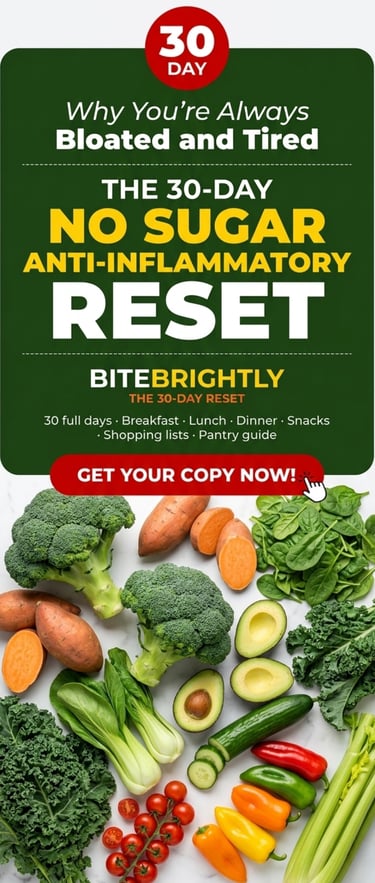

Why You're Always Bloated and Tired — And the 30-Day Anti-Inflammatory Reset That Actually Fixes It
By BiteBrightly 29 May 2026: This post might contain affiliate links.
You wake up tired despite a full night of sleep. By mid-morning you are already reaching for caffeine. After lunch the bloating starts — that uncomfortable, heavy fullness that makes your clothes feel tight and your energy disappear. By 3pm you are running on empty. By evening you are exhausted but somehow cannot sleep properly. And then it starts again tomorrow.
If this sounds familiar, you are not alone — and more importantly, you are not broken. What you are experiencing is not a mystery, and it is not simply "getting older." It is a predictable biological response to five specific dietary patterns that are silently driving inflammation, disrupting your gut, and stealing your energy every single day.
The good news: once you understand the five causes, you also understand the solution. And the solution is more straightforward than most people expect.
You Are Not Imagining It — Chronic Bloating and Fatigue Are Epidemic
Chronic bloating and persistent fatigue are among the most commonly reported health complaints in Western countries. Research suggests that up to 30% of adults experience regular bloating, and approximately 45% report persistent fatigue that affects their daily functioning.
When most people experience these symptoms they try eating less, drinking more water, going to bed earlier, taking a multivitamin. When these things do not work, they conclude something must be specifically wrong with them — a mysterious condition, a broken metabolism, a constitution that just does not handle food well.
What the research actually shows: chronic bloating and fatigue are almost always driven by specific dietary patterns that promote systemic inflammation, disrupt the gut microbiome, and destabilise blood sugar. Remove the drivers, support the gut, reduce inflammation — and the symptoms resolve.
Cause 1: Sugar — The Inflammation Trigger Nobody Talks About
Most people know sugar is not great for them. Very few understand the specific mechanism by which it drives the bloating and fatigue they experience every day.
What Sugar Does to Your Gut
Sugar — particularly refined fructose from added sugars — is rapidly fermented by bacteria in the large intestine. When you consume more sugar than your small intestine can absorb (which happens frequently with the quantities in modern processed food), the excess reaches the colon where gas-producing bacteria feast on it. The result is the bloating, gas, and discomfort that follows a high-sugar meal with remarkable predictability.
What Sugar Does to Your Energy
When you eat refined sugar, blood glucose rises rapidly. Insulin spikes to bring it back down. Then blood glucose drops below baseline — triggering the release of cortisol and adrenaline to raise it again. This hormonal see-saw is the precise biochemical mechanism behind the energy crash that follows every high-sugar meal: the tiredness after breakfast cereal, the slump after the mid-morning biscuit, the 3pm collapse after a sugary lunch.
What Sugar Does to Inflammation
Research published in the American Journal of Clinical Nutrition confirmed that consuming added sugar significantly increases circulating inflammatory markers including CRP, IL-6, and TNF-alpha within weeks — establishing sugar consumption as a direct driver of the systemic inflammation that underlies chronic fatigue, joint pain, skin conditions, and the bloating that so many people accept as their normal.
The hidden sugar problem: Many people reduce obvious sugary foods without realising that added sugar hides under more than 50 names on food labels — dextrose, maltose, corn syrup, agave nectar, fruit juice concentrate, and many more. Reading every label is essential for genuinely reducing sugar intake rather than just eliminating the obvious sources.
Cause 2: Inflammatory Foods — Fuelling the Fire You Cannot See
Beyond sugar specifically, a cluster of commonly eaten foods drives a chronic low-grade inflammatory response that the body becomes so accustomed to it stops registering — until the cumulative damage shows up as persistent fatigue, brain fog, joint stiffness, and skin problems that seem to come from nowhere.
Gluten and Gut Inflammation
Gliadin — a protein component of gluten — triggers the release of zonulin in the intestinal lining, directly increasing intestinal permeability. When the gut barrier becomes more permeable, particles that should remain in the intestine cross into the bloodstream, triggering an immune response and systemic inflammation. Many people experience significant improvements in bloating and energy when they reduce white bread, white pasta, pastries, biscuits, and processed breakfast cereals — not because gluten is universally harmful, but because these refined grain products provide a continuous, daily inflammatory stimulus through multiple mechanisms.
Processed Meat and Advanced Glycation End Products
Processed meats — sausages, bacon, hot dogs, and deli meats — contain advanced glycation end products (AGEs) formed during high-heat processing, alongside nitrites and saturated fats that promote NF-kB inflammatory signalling. Regular consumption contributes to the baseline inflammation that underlies chronic fatigue.
Alcohol
Alcohol directly promotes inflammation and causes significant blood sugar spikes — compounding the energy destabilisation of an already inflammatory dietary pattern. It disrupts sleep architecture even in small amounts, meaning that evening drinking contributes to the morning fatigue that many people incorrectly attribute to other causes.
Cause 3: Gut Imbalance — When Your Microbiome Becomes Your Enemy
Your gut microbiome — the trillions of bacteria living in your digestive system — is not just a passive digestive aid. It is a metabolically active system that regulates immune function, influences mood and energy, produces neurotransmitters, and determines whether the food you eat produces inflammation or reduces it.
When your gut microbiome is in balance — diverse, dominated by beneficial species, well-fed with prebiotic fibre from garlic, oats, banana, and leafy greens — it produces short-chain fatty acids that maintain gut lining integrity, regulate inflammation, and directly support energy production.
When your gut microbiome is out of balance — a state called dysbiosis — the consequences ripple throughout your entire body:
Dysbiosis and bloating: An overgrowth of gas-producing bacteria produces excessive fermentation of undigested food, leading to bloating, gas, and distension that has nothing to do with how much you ate and everything to do with what your gut bacteria are doing with it.
Dysbiosis and fatigue: Dysbiotic bacteria produce LPS (lipopolysaccharide) endotoxin that, when it crosses a leaky gut lining into circulation, triggers a systemic inflammatory response that directly suppresses cellular energy production. This is the mechanism behind the profound fatigue many people experience that is completely disproportionate to their activity level.
Dysbiosis and brain fog: Research published in Cell confirmed that gut microbiome composition directly influences brain function through the gut-brain axis — connecting gut dysbiosis to the cognitive symptoms including brain fog, poor concentration, and mood instability that accompany chronic inflammation.
What causes dysbiosis: A diet low in prebiotic fibre, high in refined sugar, high in processed foods containing emulsifiers that disrupt the gut mucosal layer, insufficient fermented foods — all create the conditions for gut imbalance that manifests as bloating, fatigue, and systemic inflammation.
Cause 4: Seed Oils — The Inflammatory Oil in Almost Everything
Seed oils — refined vegetable oils including sunflower oil, corn oil, soybean oil, canola oil, margarine, and vegetable oil — are the least discussed driver of chronic inflammation on this list, and arguably one of the most significant.
The Omega-6 to Omega-3 Imbalance
The human body regulates inflammation through the balance between omega-6 and omega-3 fatty acids. Omega-6 fatty acids from seed oils are precursors to pro-inflammatory signalling molecules. Omega-3 fatty acids from oily fish (salmon, mackerel, sardines), walnuts, chia seeds, and flaxseeds are precursors to anti-inflammatory compounds.
The optimal ratio for human health is approximately 4:1. The modern Western diet, dominated by seed oils in almost every processed food, has an omega-6 to omega-3 ratio estimated at 15:1 to 20:1.
This means the body's inflammatory signalling is overwhelmingly weighted toward chronic, low-grade pro-inflammatory activity — the dietary foundation of the fatigue, joint discomfort, gut inflammation, and skin problems that so many people normalise as inevitable.
Where Seed Oils Are Hidden
The pervasive problem is that seed oils are in virtually every processed food — crackers, bread, ready meals, sauces, dressings, baked goods, and even products marketed as healthy. Eliminating them requires cooking at home with extra-virgin olive oil or coconut oil, and reading ingredient labels carefully for sunflower oil, vegetable oil, canola oil, and margarine.
Cause 5: Refined Carbohydrates — The Blood Sugar Rollercoaster
Refined carbohydrates — white bread, white pasta, pastries, biscuits, and processed breakfast cereals — have had their fibre and nutrients stripped away during processing, leaving primarily starch that is rapidly digested to glucose.
The Rapid Glucose Spike
White bread has a glycemic index of approximately 71 — higher than table sugar. Without the fibre that slows digestion in whole grains, refined carbohydrates produce the same blood glucose spike-crash cycle as sugar, with the same consequences for energy, mood, and inflammation.
The fix is straightforward: swap white bread, white pasta, and processed cereals for quinoa, brown rice, oats, buckwheat, sweet potato, and millet — the whole grain options that provide slow-release energy alongside the fibre that feeds beneficial gut bacteria.
Refined Carbohydrates and Gut Dysbiosis
The gut microbiome depends on dietary fibre for survival. Beneficial bacteria — Lactobacillus, Bifidobacterium, Akkermansia — ferment dietary fibre to produce the short-chain fatty acids that maintain gut health. Refined carbohydrates provide almost no fibre, systematically starving the beneficial bacteria that keep the gut balanced and creating the conditions for the dysbiosis, bloating, and inflammation that compound across time.
The Inflammatory Glycation Pathway
Research confirmed that chronically elevated blood glucose from regular refined carbohydrate consumption produces advanced glycation end products (AGEs) that directly activate NF-kB inflammatory signalling — driving the systemic inflammation that compounds with the other four causes to produce the chronic fatigue and gut disruption that many people accept as their daily baseline.
The Common Thread — And Why Conventional Advice Misses It
Look at all five causes together:
Sugar — drives gut fermentation, blood glucose dysregulation, and direct systemic inflammation
Inflammatory foods — triggers gut permeability, immune activation, and chronic baseline inflammation
Gut imbalance — produces LPS endotoxin, disrupts energy production, causes brain fog and fatigue
Seed oils — creates a 15–20:1 omega-6:omega-3 imbalance that drives continuous pro-inflammatory signalling
Refined carbohydrates — spikes blood glucose, starves beneficial gut bacteria, produces AGE inflammatory compounds
They all contribute to the same outcome: chronic systemic inflammation that impairs energy production, disrupts gut function, and produces the relentless fatigue and bloating that have become the background condition of modern life.
Conventional dietary advice — eat less, move more, choose low-fat, manage portions — addresses none of these mechanisms. It focuses on caloric balance while ignoring the inflammatory quality of what is being eaten. This is why so many people follow conventional advice, see modest short-term results, and find themselves back where they started. They reduced calories without reducing inflammation.
The 30-Day Anti-Inflammatory Reset — The Structured Solution
Understanding the five causes is the beginning. But understanding alone does not change your gut microbiome, reduce your inflammatory markers, or stabilise your blood sugar. What changes those things is consistency — a sustained period of removing the inflammatory inputs and replacing them with the anti-inflammatory foods and habits that allow your body to genuinely heal.
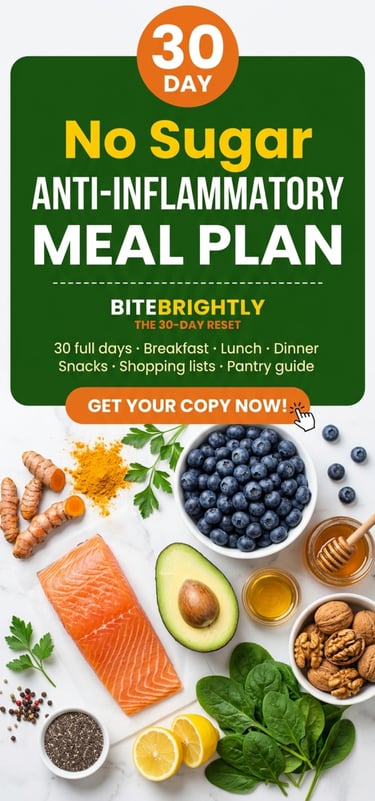
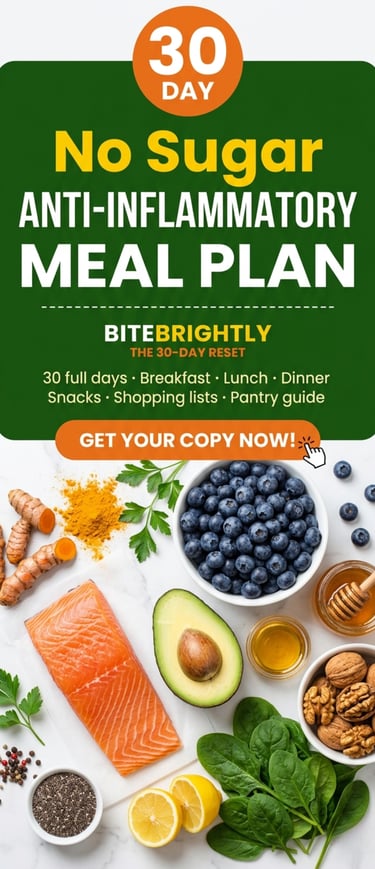
This is exactly what the 30-Day No Sugar Anti-Inflammatory Meal Plan is designed to do.
What the Plan Actually Contains
The plan gives you a completely done-for-you 30-day framework built around the seven anti-inflammatory eating principles:
✅ Eating the rainbow — 3 or more different coloured vegetables or fruits daily, each providing unique antioxidants and anti-inflammatory compounds
✅ Prioritising omega-3 fats — salmon, mackerel, sardines, walnuts, chia seeds, and flaxseeds featured consistently throughout the plan
✅ Choosing whole grains — quinoa, brown rice, oats, buckwheat, and sweet potato replacing white bread and white rice at every meal
✅ Spicing every meal — turmeric paired with black pepper (which increases curcumin absorption by up to 2,000%), ginger, garlic, cinnamon, and rosemary used generously throughout
✅ Cutting hidden sugars — the plan is completely free of added sugar, with every meal built from whole, unprocessed ingredients
✅ Supporting gut health — fermented foods including yoghurt and miso, prebiotic fibre from garlic, oats, and banana, and daily leafy greens
✅ Eliminating bad oils — only extra-virgin olive oil and coconut oil used throughout, replacing all sunflower, canola, and vegetable oils
What Is Included
30 days of fully planned meals: Every single day has breakfast, lunch, dinner, and a snack planned for you. Week 1 starts you with turmeric oat porridge, overnight oats with hemp seeds, avocado toast on rye with boiled eggs, and lentil and spinach soup. The variety builds each week — by Week 4 you are eating miso salmon rice bowls, herb-crusted salmon, beetroot and goat cheese salads, and celebration green smoothie bowls. Every meal is anti-inflammatory by design. Every day is fully planned. There is no guesswork.
Foods to eat and foods to avoid guide: A clear, comprehensive reference showing exactly what to include (kale, spinach, blueberries, salmon, quinoa, almonds, turmeric, ginger) and what to remove (white bread, processed meat, bad oils, sugary snacks, alcohol, fizzy drinks). Reference it any time you are unsure.
Weekly shopping lists: Four printable weekly shopping lists — print, shop, tick off as you go. Every ingredient you need for that week, organised by category. Shop Saturday or Sunday, prep Sunday, and the week runs itself. No last-minute decisions, no standing in the supermarket guessing.
Anti-inflammatory pantry checklist: A complete list of pantry staples to stock before you start — grains, legumes, nuts and seeds, oils and flavourings, spices, tins and jars, and fridge essentials. Stock these once and every week of the plan becomes significantly simpler.
Anti-inflammatory spice guide: A dedicated reference guide to the six most powerful anti-inflammatory spices — turmeric, ginger, garlic, cinnamon, black pepper, and rosemary — with exactly how and where to use each one. These spices are the flavour engine of the entire plan and the science behind each one is explained clearly.
Meal prep tips and time-saving guide: The power hour system, freeze smoothie packs, batch cook proteins, chop veg in one go, big-batch soup — six specific time-saving habits that make the full 30 days sustainable in real life around a real schedule.
7-Day Quick-Start Guide: Not ready to dive straight into 30 days? The plan includes a 7-day introduction that eases you in and eliminates sugar cravings within the first 72 hours — with a specific daily focus for each of the first seven days, from clearing the kitchen on Day 1 to planning the week ahead on Day 7.
What You Experience Week by Week
Week 1 — The Hardest and Most Important Week: The plan begins with foods your body already knows — turmeric porridge, avocado toast, baked salmon, chicken with sweet potato. The focus is removing the five inflammatory drivers completely. Sugar withdrawal is real and temporary — Days 3 and 4 can bring fatigue and cravings. The plan's 7-Day Quick-Start Guide walks you through this specifically, including what to eat when cravings peak (more protein and healthy fat at every meal). By Day 5, most people notice their energy beginning to even out.
Week 2 — The First Meaningful Shifts: Week 2 introduces more variety — buckwheat pancakes with berries, miso soup with edamame, salmon and cucumber rice paper rolls, chicken coconut curry with cauliflower rice. The gut microbiome is beginning to shift as prebiotic foods (garlic, oats, banana, leafy greens) feed beneficial bacteria and fermented foods (coconut yoghurt, miso) begin restoring diversity. Most people notice the first significant reduction in daily bloating this week.
Week 3 — Energy Stabilises: Week 3 deepens the anti-inflammatory food foundation — golden milk oats, sardine open rye sandwiches, tuna stuffed avocado halves, miso glazed eggplant, salmon fishcakes. Energy levels begin to genuinely stabilise as blood glucose stops spiking and crashing. The afternoon slump that was previously guaranteed starts to ease. Many people report sleeping more deeply.
Week 4 — Integration and Celebration: Week 4 — the longest at nine days — celebrates what you have built. Herb-crusted salmon, beetroot and goat cheese salad, baked sea bass, turkey and veg stuffed peppers, the celebration green smoothie bowl on Day 30. By Week 4, the majority of people completing this reset report significantly reduced or eliminated chronic bloating, meaningfully improved and stable energy, better sleep quality, clearer skin, and improved mood.
The Plan Is Designed for Real Life
No exotic or expensive ingredients. No hours of daily cooking. The power hour system means one Sunday prep session — cooking grains, roasting veg, boiling eggs — provides the base for most of the week's meals. The shopping lists are straightforward and built around accessible supermarket ingredients. The 80/20 rule is built in: if you slip up, you get back on track with your next meal. Progress beats perfection.
Your Next Step
If you recognise yourself in the five causes — if chronic bloating and persistent fatigue are the background condition of your daily life — the 30-Day No Sugar Anti-Inflammatory Meal Plan gives you the structured, done-for-you framework to change that.
Not a vague recommendation to eat more vegetables. Not a list of superfoods to add to your current inflammatory diet. A complete, practical, day-by-day meal plan with weekly shopping lists, a pantry guide, a spice guide, a 7-day quick-start guide, and the meal prep system that makes all 30 days genuinely achievable in real life.
Get the 30-Day No Sugar Anti-Inflammatory Meal Plan here →
Thirty days from now you could be the person who wakes up with genuine energy, gets through the afternoon without reaching for caffeine, and no longer unbuckles their jeans after lunch. That person is not a different person with a different metabolism. It is you, eating differently. It starts today.
Frequently Asked Questions
What exactly is included in the plan?
The plan includes 30 days of fully planned meals (breakfast, lunch, dinner, and snacks for every day), four weekly grocery shopping lists, an anti-inflammatory pantry checklist, a foods to eat and avoid guide, an anti-inflammatory spice guide, a meal prep tips and time-saving guide, and a 7-day quick-start guide for people who want to ease in before committing to the full 30 days. It is a printable PDF designed to be used alongside your existing kitchen and supermarket.
Will I feel worse before I feel better?
For people with significant sugar and refined carbohydrate intake, Days 3 and 4 can involve temporary fatigue, headaches, and cravings as the body adjusts. This is normal and temporary — it is sugar withdrawal, and it passes. The 7-Day Quick-Start Guide specifically addresses this, advising you to eat more protein and healthy fat when cravings peak. By Day 5, most people notice their energy beginning to even out. The hardest part is the first four days, and the plan walks you through them specifically.
Is this suitable for everyone?
The plan is designed for healthy adults who want to reduce chronic bloating, improve energy levels, and reduce systemic inflammation through dietary change. People with diagnosed conditions including coeliac disease, inflammatory bowel disease, type 1 or type 2 diabetes, or any other health condition requiring dietary management should consult their healthcare provider before beginning. It is not designed as a medical treatment — it is a dietary resource for general wellness and anti-inflammatory eating.
References and Further Reading
Giugliano D et al. — American Journal of Clinical Nutrition (2006) — The effects of diet on inflammation Comprehensive review confirming that added sugar, refined carbohydrates, and omega-6-rich seed oils are primary dietary drivers of systemic inflammation.
Wastyk HC et al. — Cell (2021) — Gut-microbiota-targeted diets modulate human immune status Stanford research confirming that dietary change directly and rapidly modifies gut microbiome composition and systemic inflammatory markers.
Sonnenburg JL and Bäckhed F — Nature (2016) — Diet-induced alterations in gut microflora Landmark research establishing that dietary diversity and fibre content are the primary modifiable determinants of gut microbiome health.
Bhupathiraju SN and Hu FB — Nutrients (2020) — Refined carbohydrates, glycation, and inflammation Research confirming that chronically elevated blood glucose from refined carbohydrate consumption produces AGEs and NF-kB-mediated systemic inflammation.
About the Author
I'm Judith, a wellness enthusiast and Applied Bio Sciences and Biotechnology graduate behind BiteBrightly. With a deep-rooted belief in the healing power of food, my nutrition journey began with a personal transformation — I improved my eyesight through targeted dietary changes. This life-changing experience sparked my mission to empower others by sharing evidence-based insights into food as medicine.
I created the 30-Day No Sugar Anti-Inflammatory Meal Plan because I know from both personal experience and years of research that the bloating and fatigue most people accept as normal are almost entirely driven by five specific dietary patterns — and that 30 days of structured, anti-inflammatory eating is enough to change everything.
Get the complete 30-day meal plan here →
Follow me on Pinterest for daily health tips, recipes, and wellness inspiration.
Important Notice: The information in this article is for educational purposes only and is not intended as medical advice. I am not a medical doctor or registered dietitian. Chronic bloating and fatigue can be symptoms of various medical conditions that require professional diagnosis and treatment. If you are experiencing persistent or severe symptoms, please consult a qualified healthcare provider before making dietary changes. The 30-Day Anti-Inflammatory Meal Plan is a dietary resource for general wellness — it is not a treatment for any diagnosed medical condition. These statements have not been evaluated by the FDA.
Related Posts
Connect
Join our newsletter for fresh health tips
© 2026. All rights reserved.