Vegan Magnesium Sources: The Complete Plant-Based Guide
Pumpkin seeds: 156mg magnesium per 28g (39% RDA). Cooked spinach: 157mg per cup. Tahini: 95mg per 2 tbsp. Complete vegan magnesium guide with amounts.
by BiteBrightly
5/27/202615 min read
Vegan Magnesium Sources: The Complete Plant-Based Guide
By BiteBrightly 27 May 2026: This post might contain affiliate links.
Magnesium is involved in over 300 enzymatic reactions in the human body — from energy production and protein synthesis to muscle function, nerve transmission, blood pressure regulation, and the production of DNA and RNA. It is one of the most metabolically essential minerals available, and it is one of the most commonly deficient.
Estimates suggest that between 48 and 68 percent of adults in the United States do not consume adequate magnesium from their diets. For vegans and plant-based eaters, the picture is more nuanced — plant foods are genuinely excellent sources of magnesium, and a well-constructed plant-based diet can easily provide adequate magnesium. But several factors specific to plant-based eating — phytic acid in legumes and grains, oxalic acid in certain vegetables, and the absence of some animal-based magnesium sources — mean that understanding which plant foods are richest in magnesium, and how to optimise absorption, is genuinely worthwhile.
This guide covers every significant vegan magnesium source, the science behind why magnesium matters, how to calculate your needs, and how to build a plant-based diet that consistently meets them.
Key Takeaways
The RDA for magnesium is 400–420mg daily for adult men and 310–320mg for adult women — needs increase slightly during pregnancy (350–360mg) and breastfeeding
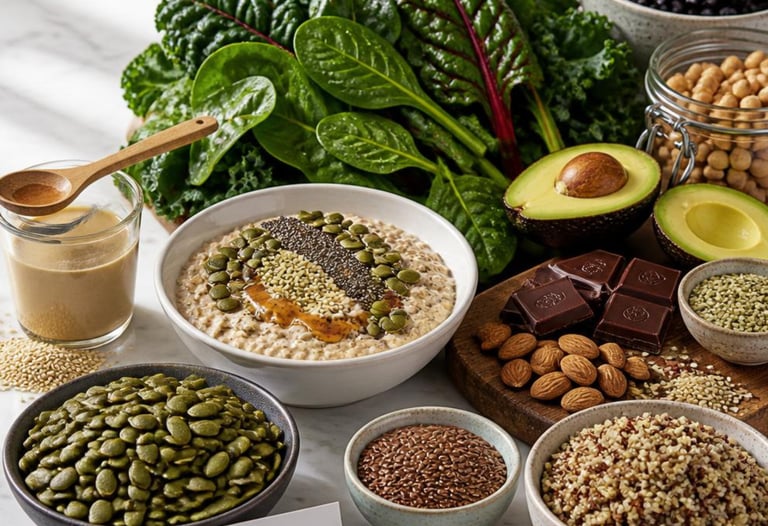
Dark leafy greens (particularly spinach and Swiss chard), seeds (pumpkin seeds and hemp seeds), legumes (black beans, edamame, lentils), whole grains (oats, quinoa, brown rice), nuts (almonds, cashews), dark chocolate, and avocado are the best vegan magnesium sources
Research published in Nutrients confirmed that dietary magnesium intake is inversely associated with systemic inflammation, type 2 diabetes risk, cardiovascular disease, and depression — establishing magnesium adequacy as one of the most consequential dietary priorities available
Phytic acid in whole grains and legumes reduces magnesium absorption by binding to it in the digestive tract — soaking, sprouting, fermenting, and cooking these foods significantly reduces phytic acid content and improves magnesium bioavailability
Oxalic acid in spinach and Swiss chard also binds to magnesium, but the extraordinary magnesium content of these greens means that meaningful magnesium is still absorbed even with the binding — they remain among the most valuable vegan magnesium foods
A systematic review confirmed that magnesium supplementation significantly reduced blood pressure, fasting blood glucose, and inflammatory markers in multiple clinical trials — supporting the clinical importance of adequate intake for cardiometabolic health
Why Magnesium Matters — The Science
Energy Production
Every cell in your body uses ATP (adenosine triphosphate) as its primary energy currency. Magnesium is required for ATP to be active — magnesium binds to ATP to form the Mg-ATP complex that enzymes can actually use. Without adequate magnesium, cellular energy production is impaired at its most fundamental level — explaining why fatigue is one of the earliest and most consistent symptoms of magnesium deficiency.
Muscle Function and Sleep
Magnesium acts as a natural calcium antagonist at muscle cell receptors — calcium triggers muscle contraction, and magnesium enables relaxation. Adequate magnesium is required for muscles to fully relax after contraction. This is why muscle cramping, particularly nocturnal leg cramps, is a classic symptom of magnesium insufficiency.
In the brain, magnesium activates GABA (gamma-aminobutyric acid) receptors — the inhibitory neurotransmitter system that quiets nervous system activity and enables sleep and relaxation. Low magnesium is associated with poor sleep quality, difficulty falling asleep, and more frequent night waking. Several clinical trials have confirmed that magnesium supplementation improves sleep quality in older adults and in people with insomnia.
Cardiovascular and Blood Pressure
Magnesium is required for the sodium-potassium ATPase pump that maintains the electrochemical gradient across cell membranes — the gradient that regulates blood pressure, heart rhythm, and vascular smooth muscle tone. Low magnesium allows vascular smooth muscle to contract more readily, raising blood pressure. Higher dietary magnesium is consistently associated with lower blood pressure in large epidemiological studies.
Blood Sugar and Insulin Sensitivity
Magnesium is a cofactor for the insulin receptor tyrosine kinase — the enzyme that must be activated before cells can respond to insulin and take up glucose from the blood. Magnesium deficiency reduces the sensitivity of this receptor, contributing to insulin resistance. Research has found that people with type 2 diabetes have significantly lower blood magnesium levels than controls, and that higher dietary magnesium intake is associated with lower type 2 diabetes risk.
Mental Health
Magnesium modulates the NMDA receptor — a glutamate receptor involved in learning, memory, and mood. Under normal magnesium status, magnesium blocks the NMDA receptor at rest and requires a specific depolarisation signal to allow receptor activation. Magnesium deficiency removes this regulation, contributing to the excessive NMDA receptor activation that has been associated with anxiety, depression, and stress-induced neurological damage. Research has found significant associations between low dietary magnesium and higher rates of depression and anxiety.
Understanding Magnesium Bioavailability in Plant Foods
Before the food list, a critical concept: the magnesium content listed on nutrition labels reflects total magnesium, not absorbable magnesium. How much magnesium you actually absorb from plant foods depends on several factors:
Phytic Acid
Phytic acid (phytate) is the primary storage form of phosphorus in plant seeds, grains, and legumes. It binds strongly to minerals including magnesium, iron, zinc, and calcium in the digestive tract, forming insoluble mineral-phytate complexes that cannot be absorbed. This is why whole grains and legumes — despite their high total magnesium content — have reduced magnesium bioavailability compared to their labels suggest.
How to reduce phytic acid:
Soaking: Soaking grains and legumes overnight activates phytase enzymes that break down phytic acid. Drain and rinse the soaking water before cooking — the phytic acid leaches into the water
Sprouting: Germinating grains and legumes significantly increases phytase activity and reduces phytic acid by 50% or more
Fermentation: Sourdough fermentation dramatically reduces phytic acid in bread through phytase activity during fermentation — genuinely one of the best reasons to choose sourdough bread over standard yeast bread
Cooking: Boiling beans significantly reduces their phytic acid content — discarding the cooking water removes additional phytate
Oxalic Acid
Oxalic acid in spinach, Swiss chard, beet greens, and rhubarb binds to some minerals including magnesium. Despite this, spinach remains one of the best dietary magnesium sources because its total magnesium content is so high that meaningful amounts are absorbed even after oxalate binding. Cooking reduces oxalate content slightly.
Vitamin D Status
Vitamin D influences magnesium absorption in the intestine — adequate vitamin D status supports better magnesium absorption. For vegans, who are already at higher risk of vitamin D deficiency (particularly in low-sunlight months), maintaining adequate vitamin D through fortified foods or supplementation also supports magnesium status.
Gut Health
A healthy gut microbiome and intact intestinal lining support better mineral absorption generally. The same plant-based dietary diversity that supports magnesium intake also supports the gut health that improves its absorption.
The Best Vegan Magnesium Sources
Seeds — The Most Concentrated Plant Magnesium Source
Pumpkin seeds (pepitas): 156mg per 28g (39% RDA)
Pumpkin seeds are the single richest easily available vegan magnesium source — providing 156mg of magnesium per 28g serving (approximately 2 tablespoons). This means two tablespoons of pumpkin seeds provides 39% of the daily magnesium requirement in a small, convenient, versatile format.
Beyond magnesium, pumpkin seeds provide 7g of protein, 2.2mg of zinc (the immune mineral that is commonly low in plant-based diets), and 265mg of plant sterols per 28g — making them simultaneously one of the best vegan magnesium, zinc, and plant sterol sources available.
How to use them: Scattered on oatmeal, yogurt, or salads. In homemade granola. As a snack on their own. Blended into pumpkin seed butter. Two tablespoons daily makes a meaningful contribution to magnesium intake.
Hemp seeds: 210mg per 100g (53% RDA per 3 tablespoons)
Hemp seeds are nutritionally extraordinary — providing not just abundant magnesium but complete protein (all nine essential amino acids) at 10g per three tablespoons, ALA omega-3, and GLA (an unusual anti-inflammatory omega-6). Three tablespoons of hemp seeds provides approximately 90mg of magnesium (approximately 22% of the daily RDA) alongside their full nutritional profile.
How to use them: Hemp seeds have a mild, slightly nutty flavour that works in almost any food context — smoothies, salads, oatmeal, yogurt, soups, grain bowls. They require no preparation and dissolve into food rather than adding a distinct texture.
Flaxseeds (ground): 111mg per 100g
Ground flaxseeds provide magnesium alongside their ALA omega-3 and lignan anti-inflammatory compounds. The ground form is essential — whole flaxseeds pass through the digestive tract largely undigested, providing almost none of the nutritional benefit. One tablespoon of ground flaxseed provides approximately 27mg of magnesium.
How to use them: One to two tablespoons stirred into oatmeal, yogurt, or smoothies daily. Store in the fridge to prevent ALA oxidation.
Chia seeds: 335mg per 100g (approximately 95mg per 2 tablespoons)
Chia seeds provide more magnesium by weight than almost any other commonly eaten food — 335mg per 100g. Two tablespoons (approximately 28g) provides approximately 95mg of magnesium — nearly a quarter of the daily RDA in a single serving. Unlike flaxseeds, chia seeds can be eaten whole (their outer shell is permeable, allowing absorption) and have the hydrogel-forming property that provides sustained water release and additional gut health benefits.
How to use them: Chia pudding soaked in plant milk overnight. Added to smoothies. Sprinkled on salads and oatmeal. The hydrogel property means they expand significantly when soaked — a small amount goes a long way.
Sesame seeds and tahini: 351mg per 100g
Sesame seeds are one of the richest magnesium sources available, providing 351mg per 100g. Tahini — sesame seed paste — provides approximately 95mg of magnesium per two tablespoons, making it one of the most magnesium-dense condiment-format foods available.
How to use them: Tahini as a sauce base for salad dressings, stir-fries, and noodle dishes. Sesame seeds scattered on Asian dishes, grain bowls, and avocado toast. Hummus — which is tahini-based — provides meaningful magnesium from both the tahini and the chickpeas.
Dark Leafy Greens — Volume Magnesium Sources
Cooked spinach: 157mg per 1 cup cooked
Cooked spinach is one of the single highest-magnesium foods available — a cup of cooked spinach provides 157mg of magnesium, nearly 40% of the daily RDA. Raw spinach provides less per cup (because a cup of raw spinach is mostly air — cooking concentrates it dramatically), but two large handfuls of raw spinach cooked down provide the full 157mg.
The oxalic acid in spinach does bind to some magnesium, but the total magnesium content is high enough that meaningful amounts are still absorbed. Cooking reduces oxalate content slightly, marginally improving absorption.
How to use it: Wilted into pasta sauces, lentil soups, curries, stir-fries, and egg dishes. A large handful wilted in any dish adds meaningful magnesium without changing the flavour significantly.
Swiss chard: 150mg per 1 cup cooked
Swiss chard provides similarly impressive magnesium content to spinach — 150mg per cup cooked — alongside potassium and vitamins K, A, and C. Like spinach, it contains oxalic acid, and the same considerations apply.
How to use it: Sautéed with olive oil, garlic, and lemon. Added to soups and stews. Swiss chard has a slightly more robust texture than spinach and holds up better to longer cooking.
Kale: 31mg per 1 cup cooked
Kale provides less magnesium per serving than spinach or Swiss chard but has significantly lower oxalic acid content, meaning the magnesium it provides is more bioavailable. It also provides sulforaphane precursors, vitamin K, and vitamin C — a different but complementary nutritional profile.
Edamame: 64mg per 1 cup
Fresh or frozen edamame provides 64mg of magnesium per cup alongside 17g of complete protein (all nine essential amino acids) and a glycemic index of approximately 18 — one of the lowest GI foods available. The combination of magnesium, protein, and low GI makes edamame nutritionally exceptional in multiple simultaneous dimensions.
How to use it: Steamed with sea salt as a snack. In grain bowls. In Asian-inspired salads. In stir-fries.
Legumes — Fibre and Magnesium Together
Black beans: 120mg per 1 cup cooked
Black beans provide 120mg of magnesium per cup alongside 15g of fibre — the combination of magnesium and fibre in a single food makes them particularly valuable. The anthocyanins that give black beans their dark colour provide independent anti-inflammatory activity, and their resistant starch feeds Akkermansia gut bacteria.
Soaking note: Soaking and rinsing black beans before cooking improves magnesium bioavailability by reducing phytic acid content.
Kidney beans: 74mg per 1 cup cooked
Chickpeas: 79mg per 1 cup cooked
Lentils: 71mg per 1 cup cooked
All legumes provide meaningful magnesium alongside their plant protein and fibre. Lentils require no soaking and cook quickly — making them the most practically convenient legume for daily magnesium contribution. Research has consistently found that legume consumption is associated with significantly lower rates of cardiovascular disease, type 2 diabetes, and all-cause mortality — the magnesium alongside fibre and plant protein is part of this protective effect.
Whole Grains — Sustained Magnesium with Fibre
Oats: 63mg per 1 cup dry rolled oats
Oats are the most commonly consumed whole grain in plant-based eating and provide meaningful magnesium alongside their beta-glucan fibre (which has the most robust clinical evidence for LDL cholesterol reduction of any dietary fibre). One cup of dry rolled oats provides approximately 63mg of magnesium.
Quinoa: 118mg per 1 cup cooked
Quinoa stands out among grains because it provides complete protein (all nine essential amino acids) alongside its substantial magnesium content. A cup of cooked quinoa provides 118mg of magnesium — nearly a third of the daily RDA — alongside 8g of complete protein. Its GI (approximately 53) is lower than most grains.
Brown rice: 84mg per 1 cup cooked
Buckwheat: 86mg per 1 cup cooked
Buckwheat — despite its name — is not wheat and is completely gluten-free. It provides 86mg of magnesium per cup cooked alongside the flavonoid rutin, which has direct anti-inflammatory and capillary-strengthening activity.
Sourdough bread: variable but significantly higher than standard bread
The fermentation process in sourdough bread dramatically reduces phytic acid compared to standard yeast-leavened bread — improving the bioavailability of the magnesium (and other minerals) in the grain. A slice of genuine sourdough whole grain bread provides more bioavailable magnesium than equivalent whole grain bread made with commercial yeast.
Nuts — Magnesium with Healthy Fats
Almonds: 80mg per 28g (approximately 23 almonds)
Almonds provide 80mg of magnesium per 28g alongside 59mg of plant sterols, 6g of protein, and significant vitamin E. They are among the most magnesium-dense nuts available.
Cashews: 83mg per 28g
Cashews provide slightly more magnesium than almonds per 28g serving, alongside their characteristic creamy texture that makes them valuable in plant-based cooking as a cream and cheese substitute.
Brazil nuts: 107mg per 28g
Brazil nuts provide significant magnesium alongside their extraordinary selenium content (approximately 544mcg per 28g — over 900% of the daily requirement). However, the very high selenium content means Brazil nuts should be eaten in limited quantities — one to three per day is adequate for selenium needs; more can lead to selenium toxicity over time.
How to use nuts for magnesium: A small handful (25–30g) of almonds or cashews as a daily snack provides a meaningful magnesium contribution. Nut butter (almond butter, cashew butter) provides magnesium in a format that integrates into smoothies, oatmeal, and sauces.
Dark Chocolate — The Most Enjoyable Vegan Magnesium Source
Dark chocolate 70%+ cacao: 64mg per 28g serving
Dark chocolate provides a genuinely meaningful 64mg of magnesium per 28g (one ounce) alongside flavanols that have documented cardiovascular anti-inflammatory activity, insulin-sensitising effects, and BDNF-stimulating neurological benefits. The higher the cacao percentage, the more magnesium per serving — 85%+ dark chocolate provides approximately 80–90mg per 28g.
Raw cacao powder provides approximately 429mg of magnesium per 100g — making it one of the most concentrated magnesium sources available, and genuinely relevant as a daily addition to smoothies, oatmeal, or energy balls.
How to use it: A daily 28g portion of 70%+ dark chocolate (eaten mindfully rather than mindlessly) provides meaningful magnesium alongside significant flavanol benefits. Raw cacao powder in smoothies, overnight oats, and energy balls. Cacao nibs scattered on oatmeal or yogurt.
Avocado
Avocado: 58mg per medium avocado
A medium avocado provides 58mg of magnesium alongside 975mg of potassium (the most potassium-rich commonly eaten fruit), 10g of fibre, and the oleic acid that activates OEA satiety signalling. Avocado provides magnesium in a fat-rich, fibre-rich matrix that significantly slows its absorption — producing a sustained, well-modulated delivery.
Bananas
Banana: 32mg per medium banana
Bananas are an accessible and universally accepted magnesium source — the most practical everyday magnesium contribution for people who find seeds and dark leafy greens challenging to include consistently. One banana provides approximately 32mg of magnesium alongside potassium and vitamin B6.
The Vegan Magnesium Day — Practical Planning
How to reach 400mg from plant foods:
Breakfast (approximately 120mg):
1 cup overnight oats with 2 tbsp pumpkin seeds (156mg) + 1 tbsp ground flaxseed (27mg) + 1 tbsp hemp seeds (30mg) + banana (32mg) = approximately 245mg from breakfast alone with strong planning
A simpler breakfast combination:
½ cup dry oats cooked with 2 tbsp pumpkin seeds on top: approximately 60mg + 78mg = 138mg
Lunch (approximately 100–120mg):
Large salad with edamame (64mg), 2 tbsp tahini-based dressing (95mg), and mixed greens (15mg) = approximately 174mg from lunch
Dinner (approximately 100–120mg):
Lentil or black bean dal with cooked spinach wilted in (120mg lentils + 157mg spinach = 277mg from these two ingredients alone, before the rest of the meal)
Snacks and additions (approximately 60–80mg):
28g almonds as a snack (80mg)
28g dark chocolate (64mg)
Reality check:
A single well-planned day of plant-based eating can easily reach 400mg of magnesium without any supplementation — the challenge is consistency rather than possibility. The most practical approach: identify the two or three highest-magnesium foods you genuinely enjoy and include them daily (pumpkin seeds on oatmeal, tahini in dressings, cooked spinach in evening meals, dark chocolate daily), and let the rest of the diet's smaller contributions accumulate alongside.
Signs of Magnesium Deficiency
Early or mild magnesium deficiency can produce:
Fatigue and low energy disproportionate to activity
Muscle cramps or twitching (particularly nocturnal leg cramps)
Poor sleep quality or difficulty staying asleep
Anxiety or heightened stress response
Headaches or migraines (magnesium deficiency is one of the most common nutritional factors in migraine)
Irregular heartbeat or heart palpitations
Constipation
These symptoms overlap with many other conditions and are not diagnostic of magnesium deficiency on their own. If you are experiencing multiple symptoms, a blood magnesium test can be requested from your doctor — though note that serum magnesium is not a fully reliable measure of total body magnesium (most body magnesium is intracellular or in bone) and a normal serum magnesium does not rule out intracellular deficiency.
Magnesium Supplements for Vegans — A Practical Guide
For vegans who want to supplement in addition to dietary sources, different forms of magnesium have different bioavailability, side effects, and appropriate uses:
Magnesium glycinate: The most bioavailable and best-tolerated form for most people. Glycine (the amino acid component) has its own calming properties. Best for sleep support, anxiety reduction, and general supplementation. Unlikely to cause digestive issues at normal doses.
Magnesium malate: Good bioavailability with malic acid that supports cellular energy production. Useful for fatigue and energy-related concerns.
Magnesium citrate: Good bioavailability, widely available and affordable. At higher doses can have a laxative effect — useful for constipation but a consideration if you are sensitive.
Magnesium oxide: The most commonly sold form (and the cheapest) — but has very poor bioavailability (approximately 4%). Generally not the best choice if bioavailable supplementation is the goal.
Magnesium L-threonate: The only form that has demonstrated ability to cross the blood-brain barrier effectively — making it specifically relevant for cognitive and mood applications. More expensive than other forms.
Dose: 200–400mg of elemental magnesium daily from supplements is a typical range. Check that you are looking at elemental magnesium content, not the total weight of the magnesium compound (which includes the glycine, malate, or citrate component).
All commonly available magnesium supplements are vegan — the mineral itself is not derived from animal sources, and most capsule formats are now available in vegetarian or vegan capsule shells.
Frequently Asked Questions
Do vegans get enough magnesium?
Plant-based diets are genuinely well-suited to meeting magnesium needs — plant foods are the primary dietary source of magnesium, and animal foods are generally lower in magnesium than seeds, leafy greens, and legumes. However, consistently meeting magnesium needs requires actively including the high-magnesium plant foods in this guide rather than assuming any plant-based diet is automatically magnesium-sufficient. Research on the magnesium status of vegans is limited but suggests that vegans with diverse, whole-food diets are not at particular disadvantage compared to omnivores, while vegans eating primarily processed plant foods may have similar magnesium gaps to those on processed omnivore diets.
Does cooking reduce magnesium content?
Boiling vegetables in water does leach some magnesium into the cooking water — this is why steaming, roasting, or stir-frying preserves more magnesium than boiling. If boiling is your preferred method, using the cooking water as a soup base or sauce retains the leached magnesium. However, cooking also reduces oxalic acid content in high-oxalate vegetables (spinach, chard), which improves the bioavailability of the remaining magnesium — the net effect of cooking on usable magnesium is therefore complex and food-specific.
Can you get too much magnesium from food?
It is essentially impossible to reach toxic magnesium levels from whole food sources alone — the kidneys very efficiently excrete excess magnesium when it comes from food. Magnesium toxicity (hypermagnesaemia) can occur from very high doses of supplemental magnesium (particularly magnesium-containing laxatives or antacids in people with kidney disease). At normal supplemental doses of 200–400mg daily, the main side effect in healthy adults is loose stool from forms with higher osmotic activity (particularly magnesium citrate and magnesium oxide at higher doses).
Which is better for sleep — magnesium from food or magnesium glycinate supplements?
Both are valuable. Magnesium glycinate supplements have the most clinical trial evidence specifically for sleep improvement — the glycinate component adds its own GABA-modulating calming effects. However, consistently eating magnesium-rich foods throughout the day maintains a good overall body magnesium status that supports sleep quality continuously rather than only on evenings when a supplement is taken. The most effective approach for sleep is both: adequate dietary magnesium from food throughout the day alongside a magnesium glycinate supplement in the evening if sleep remains a concern.
References and Further Reading
Rosanoff A et al. — Nutrition Reviews (2012) — Suboptimal magnesium status in the United States: are the health consequences underestimated? Landmark review establishing that approximately 48% of Americans do not consume adequate dietary magnesium and examining the health consequences — the foundational epidemiological reference for dietary magnesium inadequacy.
Barbagallo M et al. — Nutrients (2021) — Magnesium in Aging, Health and Diseases Comprehensive review confirming the inverse association between dietary magnesium and systemic inflammation, type 2 diabetes, cardiovascular disease, and depression — establishing magnesium adequacy as a key preventive nutrition priority.
Zhang X et al. — European Journal of Epidemiology (2016) — Magnesium intake and type 2 diabetes risk Meta-analysis of 25 prospective cohort studies confirming that higher dietary magnesium intake is significantly associated with lower type 2 diabetes risk — quantifying the cardiometabolic protection of adequate magnesium intake.
Abbasi B et al. — Journal of Research in Medical Sciences (2012) — The effect of magnesium supplementation on primary insomnia in elderly Double-blind placebo-controlled trial confirming that magnesium supplementation significantly improved sleep quality, sleep efficiency, and sleep time — the clinical evidence base for magnesium's sleep-supporting role.
About the Author
I'm Judith, a wellness enthusiast and Applied Bio Sciences and Biotechnology graduate behind BiteBrightly. With a deep-rooted belief in the healing power of food, my nutrition journey began with a personal transformation — I improved my eyesight through targeted dietary changes. This life-changing experience sparked my mission to empower others by sharing evidence-based insights into food as medicine.
Drawing on my scientific background, personal experience, and ongoing research into nutrition and health, I focus on breaking down complex health topics into clear, practical, and actionable guidance. My approach combines scientific credibility with real-world application, making evidence-based nutrition accessible to everyone.
Follow me on Pinterest for daily health tips, recipes, and wellness inspiration.
Important Notice: The information in this article is for educational purposes only and is not intended as medical advice. I am not a medical doctor or registered dietitian. Individual magnesium needs vary based on age, health status, medications, and other dietary factors. People with kidney disease should not supplement with magnesium without medical supervision, as the kidneys' ability to excrete excess magnesium is essential for safety. Certain medications (including some antibiotics, diuretics, and proton pump inhibitors) affect magnesium absorption or excretion — discuss magnesium supplementation with your pharmacist or doctor if you take regular prescription medications. If you are experiencing symptoms that may indicate magnesium deficiency, please consult your healthcare provider for appropriate testing and guidance. These statements have not been evaluated by the FDA.
Connect
Join our newsletter for fresh health tips
© 2026. All rights reserved.