Top 5 Vitamins Every Woman Should Know About — Get Them From Food First
B12 is found only in animal products. 28% of women have low B12. Iron self-supplementing without testing is risky. The honest women's vitamin guide.
by BiteBrightly
7/10/202613 min read
Top 5 Vitamins Every Woman Should Know About — Get Them From Food First
By BiteBrightly 10 July 2026: This post might contain affiliate links.
Vitamins are not optional extras. They are the biochemical infrastructure behind energy production, immune function, hormonal balance, bone health, mood, and cognitive performance. And for women specifically, the research is consistent and concerning: the most commonly deficient nutrients are not rare or exotic — they are familiar vitamins that millions of women are quietly running low on without knowing it.
Studies reveal that over 70% of women are deficient or have inadequate vitamin D status, low levels of folate are found in 36% of women, 28% of women have low levels of vitamin B12, and nearly 24% of women have some form of iron deficiency — these are not marginal figures, they represent the majority of women in the case of vitamin D, and a significant proportion for the others.
This guide covers the five vitamins women most commonly need more of, the foods that provide them most effectively, and — where relevant — an honest note on when supplementation makes sense. The food sources come first throughout, because whole foods provide vitamins alongside fibre, cofactors, and synergistic nutrients that isolated supplements cannot fully replicate. Supplements are the safety net when food falls short — not the starting point.
Key Takeaways
Vitamin B12 is found naturally only in animal products — meaning vegans and vegetarians are at high risk of deficiency without supplementation, and symptoms (fatigue, numbness, cognitive changes) can develop gradually and be misattributed to other causes
Iron deficiency is the most common nutritional deficiency globally and disproportionately affects women of reproductive age due to menstrual blood loss — the symptoms (fatigue, brain fog, shortness of breath) are frequently normalised rather than recognised as a nutritional problem
Vitamin C is not only an antioxidant and immunity support — it is the essential cofactor for collagen synthesis and, critically, it dramatically increases the absorption of non-haem (plant-based) iron when consumed together; pairing iron-rich plant foods with vitamin C is one of the most impactful simple dietary habits available for women
No supplement substitutes for a varied, whole-food diet — but blood testing is the only accurate way to know your individual vitamin status, and is worth discussing with your doctor particularly for vitamin D, B12, folate, and iron
1. Vitamin D — The Vitamin Most Women Are Short On
Vitamin D is the most widespread deficiency among women globally — and the one with the most far-reaching consequences, given that nearly every cell in the body has vitamin D receptors. Its roles extend well beyond bone health: vitamin D regulates immune function, mood regulation (low vitamin D is associated with higher rates of depression), hormonal balance, and the expression of genes involved in cellular health.
Why women specifically fall short: The primary source of vitamin D is not food — it is UVB radiation from sunlight converting a cholesterol precursor in the skin to vitamin D3. This pathway is unavailable at northern latitudes during winter months, is blocked by sunscreen, is less efficient in darker skin tones, and becomes less efficient with age. Food sources provide only a fraction of what most women need.
The symptoms of deficiency: Fatigue, low mood, muscle weakness, bone pain, and increased susceptibility to infections — all of which are easily attributed to other causes and frequently go unrecognised as vitamin D deficiency.
Food sources (from highest to lowest):
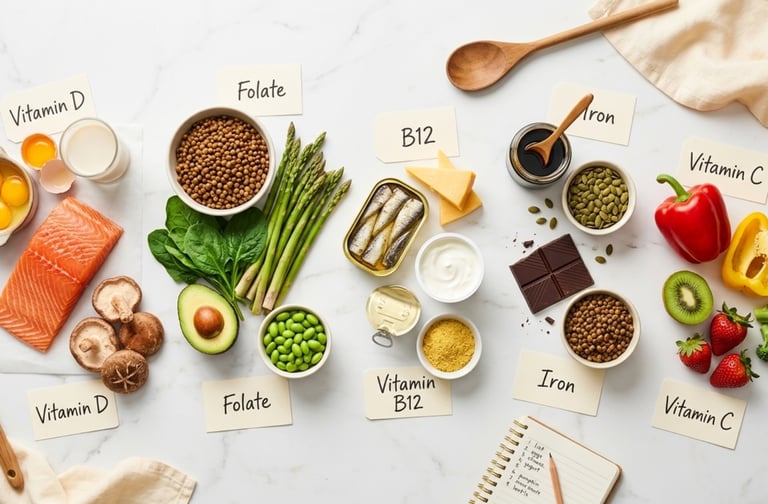
Wild salmon: 400–600 IU per 100g serving
Tinned sardines and mackerel: approximately 270 IU per 100g
Egg yolks: approximately 37–40 IU per yolk
UV-exposed mushrooms: variable but can be significant (exposing mushrooms to sunlight gills-up for 30–60 minutes before cooking dramatically increases their vitamin D content)
Fortified plant milks and fortified dairy: typically 100–120 IU per cup
Fortified cereals: variable, check the label
The food-first reality: Meeting even the conservative RDA of 600–800 IU for adults from food alone is genuinely difficult without eating oily fish several times per week. Meeting the 1,000–2,000 IU that many researchers and clinicians recommend for women, particularly in northern regions, is essentially impossible from food alone for most people.
On supplementation: Vitamin D supplementation during winter months, and year-round for women with limited sun exposure, is one of the most clearly supported supplement recommendations available. A blood test (25-OH vitamin D) is the most accurate way to know your individual status and the right dose for you. Discuss with your healthcare provider — particularly as vitamin D is fat-soluble and can accumulate, making appropriate dosing more important than for water-soluble vitamins.
2. Folate (Vitamin B9) — Critical at Every Stage, Not Just Pregnancy
Folate is frequently discussed only in the context of pregnancy, where its role in preventing neural tube defects is well established. But folate's importance extends across every woman's life — it is required for DNA synthesis and repair in every dividing cell, red blood cell formation, healthy homocysteine metabolism (relevant to cardiovascular health), and brain function.
The 2023–2025 UK data showing that 72.7% of women of reproductive age fall below the folate threshold recommended for neural tube defect protection is one of the most striking deficiency statistics in women's nutrition — particularly given that neural tube defects develop in the first four weeks of pregnancy, often before a woman knows she is pregnant.
Why women fall short: Folate is abundant in leafy greens, legumes, and fortified foods — but modern diets low in fresh vegetables and reliant on processed foods consistently underdeliver on folate. Unlike some vitamins, folate is water-soluble and heat-sensitive — overcooking vegetables significantly reduces their folate content.
Food sources (from highest to lowest):
Edamame (cooked): approximately 300mcg per cup — one of the highest single-food folate sources available
Dark leafy greens (spinach, asparagus, Brussels sprouts): 130–260mcg per cooked cup
Lentils: approximately 358mcg per cooked cup — among the most folate-dense foods available per serving
Black beans and chickpeas: approximately 250–300mcg per cooked cup
Avocado: approximately 90mcg per half
Broccoli: approximately 85mcg per cooked cup
Beetroot: approximately 136mcg per cup
Fortified breakfast cereals: typically 100–400mcg per serving (check label)
Cooking tip: Steaming rather than boiling vegetables preserves significantly more folate — boiling can destroy up to 50% of a vegetable's folate content into the cooking water.
On supplementation: Folic acid (the synthetic form of folate used in supplements and fortification) is the most recommended supplement for women who are pregnant or planning pregnancy — 400mcg daily is the standard recommendation, started ideally at least one month before conception. Some women have a genetic variation (MTHFR) that reduces their ability to convert folic acid to active folate — for these women, methylfolate supplements are more appropriate. Discuss with your doctor.
3. Vitamin B12 — The Energy and Brain Vitamin Most Plant-Based Women Are Missing
Vitamin B12 is essential for red blood cell formation, neurological function, and DNA synthesis. Its deficiency produces some of the most debilitating symptoms in nutritional medicine — profound fatigue, numbness and tingling in extremities, balance problems, cognitive changes, and in severe cases irreversible neurological damage. The insidious aspect of B12 deficiency is that the liver can store enough B12 to last 2–5 years — meaning deficiency can develop gradually over a long period before symptoms become obvious.
Why women specifically are at risk: Vitamin B12 is found naturally only in animal products — meat, fish, dairy, and eggs. This makes vegans and vegetarians structurally at risk without supplementation. Women over 50 are also at higher risk because the stomach's production of intrinsic factor (the protein required for B12 absorption) declines with age. Women taking metformin for diabetes or blood sugar management are also at elevated risk as the medication interferes with B12 absorption. Women on long-term proton pump inhibitors (PPIs) for reflux are similarly affected.
The symptoms most commonly misattributed: Fatigue from B12 deficiency is frequently attributed to iron deficiency, stress, or overwork. The neurological symptoms (tingling, balance issues, brain fog) are sometimes attributed to ageing or anxiety. Blood testing is the only accurate way to identify B12 deficiency.
Food sources (from highest to lowest):
Clams and oysters: the most concentrated B12 sources (84mcg and 16mcg per 100g respectively — far exceeding the 2.4mcg daily RDA in a single serving)
Sardines and salmon: approximately 8–9mcg per 100g
Beef and lamb: approximately 2–3mcg per 100g
Eggs: approximately 0.6mcg per egg (lower than often assumed — eggs are a useful but not a high-concentration B12 source)
Dairy (milk, cheese, yogurt): approximately 0.5–1.5mcg per serving
Nutritional yeast (fortified): approximately 4–8mcg per tablespoon — the most relevant plant-based B12 source
For vegans and vegetarians: There are no reliable plant-based sources of B12 — seaweed and fermented foods contain B12 analogues that do not function as B12 in the human body. Supplementation is not optional for vegans; it is necessary. A regular B12 supplement (typically 250–1,000mcg daily of cyanocobalamin or methylcobalamin, depending on dietary intake and individual factors) or a B12-fortified food (nutritional yeast, fortified plant milk) consumed daily is essential.
On supplementation: B12 supplementation is one of the clearer supplement recommendations in nutrition — for vegans, strict vegetarians, women over 50, and women taking metformin or long-term PPIs, it addresses a genuine, documented risk rather than a speculative benefit. Cyanocobalamin and methylcobalamin are both effective forms. Blood testing (serum B12, or ideally active B12/holotranscobalamin) confirms current status.
4. Iron — The Most Common Global Nutritional Deficiency, and Women Bear the Highest Burden
Iron is essential for haemoglobin production — the protein in red blood cells that carries oxygen to every cell in the body. Iron deficiency anaemia produces the most physically debilitating symptoms of any common nutritional deficiency: profound fatigue, shortness of breath on minimal exertion, brain fog and difficulty concentrating, cold intolerance, and dizziness. Even iron deficiency without clinical anaemia (low ferritin with normal haemoglobin) produces significant fatigue and cognitive impairment.
Why women disproportionately affected: Menstruation causes monthly iron losses that men do not experience — and heavy menstrual bleeding significantly compounds these losses. The daily iron RDA for women of reproductive age (18mg/day) is significantly higher than for men (8mg/day) for this reason. Pregnancy places further extraordinary demands on iron status, with requirements rising to 27mg/day.
The absorption distinction: There are two forms of dietary iron. Haem iron from meat and fish absorbs at 15–35%. Non-haem iron from plant sources absorbs at only 2–20%. This gap is significant for women eating plant-based diets, and explains why vegetarian and vegan women are at substantially higher risk of iron deficiency than omnivorous women eating equivalent iron quantities.
Vitamin C — the essential pairing for plant-based iron: Consuming vitamin C alongside non-haem iron converts it from ferric (Fe³⁺) to the more absorbable ferrous (Fe²⁺) form, increasing absorption by up to 3-fold. Squeezing lemon juice over a lentil dish, eating red pepper alongside a spinach salad, or drinking orange juice with fortified cereal are practical applications of this mechanism. This pairing is the single most impactful simple dietary habit available for women eating plant-based iron sources.
Food sources (haem iron — highest to lowest):
Clams and oysters: 3–28mg per 100g (also exceptional B12 sources)
Liver: approximately 6.5mg per 100g (also the most concentrated preformed vitamin A source)
Lean red meat: approximately 2.5–3.5mg per 100g
Tinned sardines: approximately 2.9mg per 100g
Chicken and turkey (dark meat): approximately 1.3mg per 100g
Food sources (non-haem iron — highest to lowest):
Blackstrap molasses: approximately 3.5mg per tablespoon — the most underrated plant-based iron source available
Cooked lentils: approximately 3.3mg per half cup
Tofu: approximately 2.7mg per 100g
Cooked spinach: approximately 2.7mg per 100g (pair with vitamin C)
Pumpkin seeds: approximately 2.5mg per 28g serving
Dark chocolate 70%+: approximately 3.4mg per 30g square
What to avoid alongside iron-rich meals: Tea and coffee (tannins bind iron and reduce absorption by up to 60%), high-calcium foods in large amounts, and foods high in phytic acid (bran, some grains) — all inhibit non-haem iron absorption. Allow at least an hour between these and iron-rich meals.
On supplementation: Iron supplementation should follow a confirmed deficiency diagnosis via blood test — specifically ferritin levels, not just haemoglobin alone. Self-supplementing with iron without testing is not recommended, as excess iron is harmful and iron overload (haemochromatosis) is a real condition. If your doctor confirms low ferritin or iron deficiency anaemia, supplementation under medical supervision is important — dietary change alone may be insufficient to correct established deficiency quickly enough.
5. Vitamin C — Not Just for Immunity, and Here Is Why It Matters Specifically for Women
Vitamin C is the vitamin most people associate with winter colds and orange juice. Its genuine importance for women goes significantly further than immunity — it is the essential cofactor for collagen synthesis (relevant to skin, joint health, and wound healing), a primary antioxidant protecting cells from oxidative damage, and the critical absorption-enhancer for non-haem iron described above.
For women specifically: collagen is the most abundant protein in the body, and vitamin C is literally required by the enzymes that stabilise collagen's structure. Without adequate vitamin C, the body cannot build stable collagen regardless of dietary protein intake. As collagen production naturally declines with age — particularly after menopause — maintaining the vitamin C supply that supports collagen synthesis becomes more rather than less important.
Why women may fall short: Vitamin C is water-soluble and not stored in the body in meaningful amounts — it is excreted in urine within hours. This means consistent daily intake from food matters enormously. Smoking significantly depletes vitamin C (smokers require approximately 35mg more per day than non-smokers due to increased oxidative stress). A diet heavy in ultra-processed foods and low in fresh fruits and vegetables consistently underdelivers on vitamin C.
Food sources (from highest to lowest):
Red bell peppers: approximately 190mg per medium pepper (the single highest vitamin C food source per gram — significantly more than citrus)
Yellow bell peppers: approximately 150mg per medium pepper
Kiwi: approximately 90mg per fruit
Strawberries: approximately 85mg per cup
Broccoli: approximately 90mg per cooked cup
Brussels sprouts: approximately 75mg per cooked cup
Citrus fruits (oranges, grapefruit): approximately 70mg per fruit
Papaya: approximately 90mg per 100g
Practical tip: Vitamin C is significantly reduced by cooking, particularly boiling. Eating peppers, strawberries, and citrus raw preserves maximum vitamin C. Light steaming is far preferable to boiling for broccoli and Brussels sprouts.
On supplementation: For most women eating a varied diet including regular fresh fruits and vegetables, vitamin C supplementation is less urgently needed than the other four on this list — food sources are generally more accessible for vitamin C than for vitamin D, B12, or even folate. Where supplementation is considered, 500mg daily is a common and reasonable dose. The upper tolerable limit from combined food and supplements is 2,000mg per day — above this, gastrointestinal side effects become likely. High-dose vitamin C supplementation beyond 1,000mg daily provides no established additional immune or health benefit for most healthy adults.
The Vitamins by Life Stage — A Quick Reference
In your 20s and 30s (reproductive years): Folate is the most critical — for neurological health daily, and for pregnancy preparation. Iron losses from menstruation make iron status a consistent monitoring priority. Vitamin D and B12 should be assessed, particularly if plant-based. Vitamin C is generally well-covered with a varied diet.
During pregnancy: Folate (or folic acid) supplementation from pre-conception through the first trimester. Iron requirements nearly double. Vitamin D needs increase. B12 is critical if plant-based. Discuss all supplement needs with your midwife or doctor — this is not a moment for self-directing supplementation.
In your 40s and 50s (perimenopause and menopause): Vitamin D becomes increasingly important as both sunlight conversion efficiency and bone density protection needs increase. B12 absorption may begin to decline. Iron requirements drop after menopause (to 8mg/day from 18mg/day) — meaning the iron supplementation focus from reproductive years may no longer be appropriate. Vitamin C's role in collagen support becomes more relevant.
After menopause: Vitamin D is arguably the highest priority — its role in calcium absorption, bone density, immune function, and mood regulation all become more relevant post-menopause. B12 monitoring remains important as absorption efficiency continues to decline with age.
When to Get Blood Tests
The five vitamins in this guide cannot be reliably assessed by symptoms alone — deficiencies can be subtle, gradual, and attributed to other causes for years. Blood testing is the only accurate way to know your individual status.
Tests worth discussing with your doctor:
25-OH vitamin D (blood level of vitamin D)
Serum ferritin (iron stores — more sensitive than haemoglobin alone for early deficiency)
Serum B12 or ideally holotranscobalamin (active B12) (more sensitive for early deficiency)
Serum or red cell folate
Women who have not had these tested in the past year — particularly those who are vegetarian or vegan, have heavy periods, are pregnant or planning pregnancy, or are over 50 — have good reason to discuss testing with their doctor.
Frequently Asked Questions
Should I take a women's multivitamin to cover all of these?
A quality women's multivitamin covers several of these vitamins at meaningful levels and can serve as a useful nutritional safety net alongside a varied diet. However, multivitamins are not substitutes for a varied, whole-food diet — and some of the most critical needs (particularly vitamin D and B12 for vegans) may require dedicated supplementation at higher doses than most multivitamins provide. If you take a multivitamin, check that it contains folate or methylfolate rather than just folic acid if you have MTHFR concerns, and that vitamin D is in the D3 (cholecalciferol) form rather than D2.
Are fat-soluble vitamins more risky to supplement?
Yes — vitamin D is fat-soluble and can accumulate to toxic levels if supplemented at very high doses over extended periods. Vitamins A, E, and K are also fat-soluble with similar caution warranted at high doses. By contrast, the water-soluble vitamins B12, folate, and vitamin C are generally safer in excess as they are excreted in urine — though very high-dose supplementation still warrants care. This is one reason why vitamin D supplementation specifically benefits from blood testing rather than starting at an arbitrary dose.
Do I need more of these vitamins during pregnancy?
Significantly more, for most of them. Folate requirements increase substantially (400mcg supplement before conception and through first trimester is the minimum recommendation). Iron requirements nearly double. Vitamin D needs increase. B12 is critical for neural development if plant-based. Omega-3 (DHA specifically) and iodine are also important in pregnancy and not covered by this guide's top five. Pregnancy nutrition is an area where personalised guidance from a midwife, obstetrician, or registered dietitian is particularly valuable.
References and Further Reading
Nature Made — Nutrient Deficiency Research — Study reveals women aren't getting enough of these 14 key nutrients Data confirming that over 70% of women have deficient or inadequate vitamin D status, 36% have low folate, 28% have low B12, and 24% have some form of iron deficiency.
PMC — UK Folate Status Study (August 2023 – January 2025) — Folate status shows no relationship with vitamin B12 but reiterates the urgency for folate fortification in the UK Analysis of 47,240 samples finding 72.7% of women of reproductive age below the folate threshold for neural tube defect protection, and 85.5% in women aged 21–25.
WebMD — Vitamins Women Need — Vitamins Women Need: Supplements, Vitamin C, Vitamin D, Folate, and More Medically reviewed overview of key vitamins for women at every age including the specific roles of B6, B12, and folic acid.
About the Author
I'm Judith, a wellness enthusiast and Applied Bio Sciences and Biotechnology graduate behind BiteBrightly. With a deep-rooted belief in the healing power of food, my nutrition journey began with a personal transformation — I improved my eyesight through targeted dietary changes. This life-changing experience sparked my mission to empower others by sharing evidence-based insights into food as medicine.
Follow me on Pinterest for daily health tips, recipes, and wellness inspiration.
Important Notice: The information in this article is for educational purposes only and is not intended as medical advice. I am not a medical doctor or registered dietitian. Individual nutritional needs vary significantly based on age, health status, diet, medications, and life stage. Blood testing is the only accurate way to confirm vitamin deficiency — do not self-diagnose or self-treat based on symptoms alone. Supplement use, particularly for iron and fat-soluble vitamins like vitamin D, should be discussed with a qualified healthcare provider. Women who are pregnant or planning pregnancy should seek personalised nutritional guidance from a midwife, obstetrician, or registered dietitian. These statements have not been evaluated by the FDA.
Related posts
Connect
Join our newsletter for fresh health tips
© 2026. All rights reserved.