5 Sugar-Free Herbal Tea Lollipops With Dried Fruit and Flowers (And Their Health Benefits)
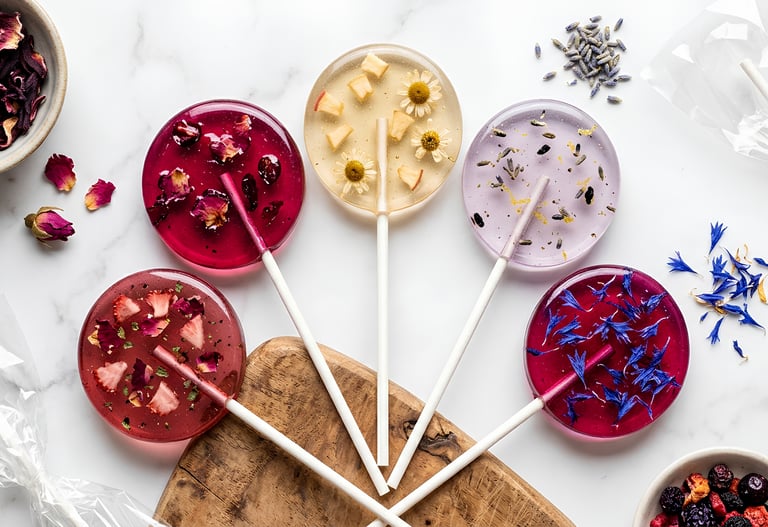
5 sugar-free herbal tea lollipops with dried fruit and real edible flowers. Hibiscus, lavender, chamomile, rose. No refined sugar, no artificial dye.
by BiteBrightly
6/22/20269 min read
5 Sugar-Free Herbal Tea Lollipops With Dried Fruit and Flowers (And Their Health Benefits)
By BiteBrightly 22 June 2026: This post might contain affiliate links.
These lollipops sit in a genuinely fun corner of healthier treat-making — herbal tea brewed strong and transformed into a sugar-free hard candy base, with dried fruit pieces and real edible flowers suspended inside for colour and flavour. They look like something from an artisan confectionery shop, and they are made without any refined sugar at all.
A quick honest note before the recipes: a lollipop is still a piece of hard candy, regardless of what sweetens it. These are not health foods, and they should be enjoyed as an occasional treat rather than a daily habit. What makes them genuinely better than a standard lollipop is the absence of refined sugar (replaced here with natural sugar alternatives), the inclusion of real herbal tea and dried botanicals that bring their own established wellness associations, and the complete absence of artificial dyes and synthetic flavouring — every colour and flavour in these five recipes comes from the actual tea, fruit, and flower used.
The Sugar-Free Hard Candy Base — How It Actually Works
Before the five recipes, it helps to understand the technique, because all five share the same base method and the same key principle: hard candy needs a sugar substitute that can reach the same "hard crack" temperature and structure that regular sugar does, without crystallising or turning grainy as it cools.
Isomalt is the most reliable choice for home sugar-free hard candy. It is derived from beet sugar but metabolised differently from regular sugar, behaves almost identically to sugar when melted, and produces the same glassy, clear, snappable texture lollipops are known for. It has a much lower effect on blood glucose than sugar.
Allulose can be blended with isomalt for a cleaner sweetness and a slight reduction in the aftertaste some people notice with isomalt alone — though allulose cannot achieve the hard-crack structure on its own and needs isomalt's crystalline support.
The basic ratio: Roughly equal parts isomalt and water, heated to between 300–310°F (150–155°C) on a candy thermometer — the "hard crack" stage. This temperature is essential; below it, the candy will be soft and sticky rather than hard and glassy.
The herbal tea infusion technique: Rather than using plain water, these recipes use strongly brewed herbal tea (steeped for double the normal time, with double the usual amount of tea, to concentrate the flavour) as the liquid component. The tea's flavour and some of its colour carry through into the finished candy.
A Note on the Flowers Used
Every flower in these five recipes is a flower with genuine, established culinary history — not a decorative addition. Hibiscus, chamomile, lavender, rose, and cornflower are all commonly used in food and drink across multiple culinary traditions. Only use flowers explicitly sold or labelled for culinary use (not flowers from a florist or garden centre intended for decoration, which may have been treated with pesticides unsuitable for consumption). Dried culinary-grade edible flowers are widely available online and from specialist food suppliers.
Recipe 1: Hibiscus Rose Lollipops With Dried Cranberry
A vivid deep pink-red lollipop, tart and floral, with small pieces of dried cranberry and a few dried rose petals suspended throughout. This is the most visually striking of the five — the hibiscus alone produces a jewel-toned ruby colour with no added dye required.
Health benefits associated with the ingredients: Hibiscus is high in vitamin C and anthocyanins, and is widely studied for its association with healthy blood pressure levels — research has explored hibiscus tea's relationship to modest reductions in blood pressure, though it should never replace prescribed blood pressure medication. Dried cranberries provide proanthocyanidins associated with urinary tract health in fresh and unsweetened forms. Rose petals have a long culinary history and a mild, calming aromatic quality.
Ingredients (makes approximately 10 lollipops):
1 cup strongly brewed hibiscus tea (4 hibiscus tea bags steeped in 1 cup boiling water for 10 minutes, then cooled)
1 cup isomalt
2 tablespoons finely chopped dried cranberries (unsweetened or naturally sweetened, no added sugar)
1 tablespoon dried culinary rose petals, crumbled
Lollipop sticks
Silicone lollipop mould
How to make it:
Brew the hibiscus tea strongly and allow to cool completely
Combine the cooled hibiscus tea and isomalt in a small, heavy-bottomed saucepan
Heat over medium heat, stirring gently until the isomalt dissolves completely
Insert a candy thermometer (not touching the bottom of the pan) and continue heating without stirring until the mixture reaches 300–310°F (hard crack stage)
Remove from heat immediately. Working quickly, stir in the chopped dried cranberries and half the rose petals
Place lollipop sticks into the silicone mould cavities
Carefully pour the hot mixture into the mould, distributing the remaining rose petals across the tops as you pour
Allow to cool completely and harden — approximately 15–20 minutes
Carefully remove from the mould once fully hardened
Storage: Wrap individually in cellophane or wax paper once fully cooled. Store in an airtight container in a cool, dry place for up to 1 month.
Recipe 2: Chamomile Honey Lollipops With Dried Apple
A pale golden lollipop with the gentle, apple-like flavour of chamomile and small flecks of dried apple suspended throughout. This is the calmest and most soothing of the five — both in flavour and in its traditional associations.
Health benefits associated with the ingredients: Chamomile has been used traditionally and is widely studied for its calming properties, with research exploring its association with improved sleep quality and reduced anxiety symptoms. Dried apple retains some of fresh apple's pectin fibre and polyphenols, though in much smaller concentration than the fresh fruit. Raw honey, used here in trace amounts as a flavour note, provides a small amount of trace antioxidants.
Ingredients (makes approximately 10 lollipops):
1 cup strongly brewed chamomile tea (4 chamomile tea bags steeped in 1 cup boiling water for 10 minutes, then cooled)
1 cup isomalt
1 teaspoon raw honey (added off-heat, for flavour only — honey will not affect the candy's structure in this small quantity)
2 tablespoons finely chopped dried apple, unsweetened
1 teaspoon dried chamomile flowers, whole or lightly crumbled
Lollipop sticks and silicone mould
How to make it:
Brew the chamomile tea strongly and cool completely
Combine the cooled tea and isomalt in a heavy-bottomed saucepan. Heat gently, stirring until dissolved
Continue heating to 300–310°F without further stirring
Remove from heat. Stir in the honey, then the chopped dried apple
Pour into the prepared mould with sticks in place, scattering whole chamomile flowers across the surface as you pour
Allow to harden completely before removing from the mould
Storage: As above — individually wrapped, airtight, cool and dry, up to 1 month.
Recipe 3: Lavender Lemon Lollipops With Dried Blueberry
A pale violet lollipop balancing floral lavender against bright lemon, with tiny pieces of dried blueberry creating small dark flecks throughout. The lavender and lemon combination is a classic pairing for good reason — the citrus brightens what could otherwise be an overly perfumed flavour.
Health benefits associated with the ingredients: Lavender is traditionally associated with calming and relaxation properties and has a long history of use in aromatherapy and culinary applications across French and Mediterranean cuisine. Lemon zest and juice provide vitamin C. Dried blueberries retain anthocyanins, though — as with all dried fruit — at lower levels than the fresh version due to the drying process.
Ingredients (makes approximately 10 lollipops):
1 cup strongly brewed lavender tea, or 1 cup water with 1 tablespoon dried culinary lavender steeped for 10 minutes and strained
1 cup isomalt
Zest of 1 lemon
1 teaspoon lemon juice
2 tablespoons finely chopped dried blueberries
1 teaspoon dried culinary lavender buds (use English lavender specifically — it has the mildest, most food-appropriate flavour)
Lollipop sticks and silicone mould
How to make it:
Steep the lavender in hot water for 10 minutes, then strain thoroughly to remove all buds (any remaining buds can scorch and turn bitter)
Combine the strained lavender liquid and isomalt in a heavy-bottomed saucepan. Heat gently until dissolved
Continue heating to 300–310°F
Remove from heat. Stir in lemon zest and lemon juice, then the chopped dried blueberries
Pour into the prepared mould, scattering a few whole lavender buds across the surface
Allow to cool and harden completely
The lavender caution: Use a light hand with lavender — it becomes soapy and overpowering very quickly if overused. A teaspoon of buds steeped for the tea is the right amount; do not be tempted to add more for a stronger flavour.
Storage: As above.
Recipe 4: Hibiscus Cornflower Berry Lollipops
A vivid two-toned lollipop — deep magenta from hibiscus with striking blue cornflower petals suspended throughout, creating a genuinely beautiful jewel-like appearance. This recipe pairs the hibiscus base from Recipe 1 with cornflower petals (also known as bachelor's button) for visual drama, alongside mixed dried berries.
Health benefits associated with the ingredients: As with Recipe 1, hibiscus provides vitamin C and anthocyanins with associations to healthy blood pressure support. Cornflower petals are primarily valued for their striking colour and mild, slightly peppery flavour, and have a long history as a culinary garnish, including in Lady Grey tea. Mixed dried berries (a combination of cranberry, blueberry, and raspberry pieces) provide a range of anthocyanins and a more complex tart-sweet flavour than any single fruit alone.
Ingredients (makes approximately 10 lollipops):
1 cup strongly brewed hibiscus tea (as in Recipe 1)
1 cup isomalt
3 tablespoons mixed finely chopped dried berries (cranberry, blueberry, raspberry — unsweetened)
1 tablespoon dried edible cornflower petals
Lollipop sticks and silicone mould
How to make it:
Brew the hibiscus tea strongly and cool completely
Combine with isomalt in a heavy-bottomed saucepan, heating gently until fully dissolved
Continue heating to 300–310°F
Remove from heat. Stir in the mixed dried berries
Pour into the prepared mould, scattering cornflower petals generously across the surface as you pour — the petals will float and create a beautiful pattern visible through the finished candy
Allow to cool and harden completely
The visual tip: Pour slowly and scatter the cornflower petals in small batches across multiple lollipops rather than all at once — this gives you more control over an even, attractive distribution rather than petals clumping in just one or two lollipops.
Storage: As above.
Recipe 5: Rose Hibiscus Lollipops With Dried Strawberry and Mint
The most fragrant and dessert-like of the five — rose and hibiscus together produce a flavour reminiscent of Turkish delight, brightened with dried strawberry pieces and finished with a small amount of dried mint for a refreshing edge.
Health benefits associated with the ingredients: The combination provides the vitamin C and anthocyanin benefits of hibiscus alongside rose's traditional calming and digestive associations. Dried strawberry retains some vitamin C and polyphenol content, though at reduced levels compared to fresh. Mint has a long traditional association with digestive comfort.
Ingredients (makes approximately 10 lollipops):
¾ cup strongly brewed hibiscus tea
¼ cup water with 1 tablespoon dried culinary rose petals steeped for 10 minutes, strained
1 cup isomalt
2 tablespoons finely chopped dried strawberry
1 teaspoon dried mint, finely crumbled
1 tablespoon dried culinary rose petals, for scattering
Lollipop sticks and silicone mould
How to make it:
Brew the hibiscus tea and separately steep the rose petals in water; cool and strain both
Combine both liquids with the isomalt in a heavy-bottomed saucepan. Heat gently until dissolved
Continue heating to 300–310°F
Remove from heat. Stir in the dried strawberry pieces and crumbled mint
Pour into the prepared mould, scattering the reserved rose petals across the surface
Allow to cool and harden completely
Storage: As above.
General Technique Notes for All Five Recipes
Work quickly once the candy reaches temperature. Sugar-free hard candy bases set faster than traditional sugar syrup once removed from heat — have your mould, sticks, and mix-in ingredients fully prepared and within reach before you start heating.
A candy thermometer is essential, not optional. Hard candy made with isomalt requires precision — a few degrees under and the candy stays soft and sticky; a few degrees over and it can scorch and discolour. An inexpensive clip-on candy thermometer removes the guesswork entirely.
Isomalt can develop a slight haze over time in humid conditions — this is a normal characteristic of the sugar alternative and does not indicate spoilage. Storing in a genuinely airtight container significantly slows this.
Silicone lollipop moulds work best for these recipes — they release the finished candy cleanly without needing oil spray, which can leave a slightly greasy residue on the surface of the finished lollipop.
Frequently Asked Questions
Are these lollipops genuinely healthy?
These are sugar-free treats made with herbal tea, dried fruit, and edible flowers rather than refined sugar and artificial flavouring — a meaningfully better composition than a standard lollipop, but still a piece of hard candy intended as an occasional treat rather than a health food. The herbal teas and flowers used do carry genuine traditional and research-associated wellness properties, but the small quantities involved in a single lollipop should be understood as a pleasant bonus rather than a meaningful dose of any therapeutic effect.
Is isomalt safe?
Isomalt is widely used in commercial sugar-free confectionery and is generally recognised as safe for most people in normal quantities. Like other sugar alcohols, it can have a mild laxative effect if consumed in large quantities, so moderation is sensible, as with any sugar-free sweetener of this type. People with specific sensitivities to sugar alcohols should be cautious.
Are these suitable for children?
As with any hard candy, lollipops carry a choking hazard for very young children and should be given only to children old enough to safely manage hard candy, with adult supervision. The flowers used should always be confirmed as culinary-grade and pesticide-free before use with children or anyone else.
Can I use fresh flowers instead of dried?
Dried flowers are strongly recommended for this recipe — fresh flowers contain water content that can interfere with the candy's hard-crack structure and introduce inconsistency to the final texture. Dried, culinary-grade flowers are the safer and more reliable choice for this specific application.
About the Author
I'm Judith, a wellness enthusiast and Applied Bio Sciences and Biotechnology graduate behind BiteBrightly. With a deep-rooted belief in the healing power of food, my nutrition journey began with a personal transformation — I improved my eyesight through targeted dietary changes. This life-changing experience sparked my mission to empower others by sharing evidence-based insights into food as medicine.
Follow me on Pinterest for daily health tips, recipes, and wellness inspiration.
Important Notice: The information and recipes in this article are for educational purposes only and are not intended as medical advice. I am not a medical doctor or registered dietitian. These are sugar-free treats, not health foods, and should be enjoyed in moderation. Only use flowers explicitly labelled and sold for culinary use — never use flowers from a florist, garden centre, or any source intended for decorative rather than food use, as these may have been treated with substances unsafe for consumption. People with specific health conditions, allergies, or sensitivities to sugar alcohols should exercise appropriate caution. These statements have not been evaluated by the FDA.
Related Posts
Connect
Join our newsletter for fresh health tips
© 2026. All rights reserved.