10 Healthy Morning Breakfast Ideas
10 healthy breakfast ideas that keep you full until lunch. Overnight oats 22g protein. Turmeric eggs. Salmon bowl 35g protein. Full recipes + Sunday prep system.
by BiteBrightly
6/16/202615 min read
10 Healthy Morning Breakfast Ideas That Actually Keep You Full Until Lunch
By BiteBrightly 16 June 2026: This post might contain affiliate links.
Breakfast sets the nutritional tone for the entire day. Research consistently confirms that what you eat within the first hour of waking influences your blood sugar stability, energy levels, cognitive performance, afternoon cravings, and total calorie intake across the rest of the day. A breakfast that provides adequate protein, fibre, and healthy fat produces a fundamentally different afternoon than one built primarily on refined carbohydrates — regardless of whether the calorie counts are similar.
Yet breakfast is also the meal most frequently skipped, rushed, or defaulted to the quickest option available. Cereal from a box. White toast with jam. A pastry grabbed on the way out the door. All of these produce the blood sugar spike-and-crash cycle that drives the 10am hunger, the 11am fatigue, and the 3pm desperate reach for caffeine or sugar that has become the background condition of most people's working days.
The ten breakfast ideas in this guide are built on the same nutritional framework: adequate protein (20–35g) to activate satiety hormones, adequate fibre (5–10g) to slow glucose absorption and feed beneficial gut bacteria, and healthy fat to provide sustained energy and support fat-soluble nutrient absorption. Every one of them takes under 15 minutes to prepare — most take under 5. And every one of them genuinely tastes like something worth eating.
Key Takeaways
Research published in the American Journal of Clinical Nutrition confirmed that a high-protein breakfast significantly reduced daily calorie intake, reduced ghrelin (the hunger hormone), and improved appetite control throughout the day compared to a low-protein breakfast of equivalent calories — establishing protein as the most important macronutrient at breakfast for satiety and weight management
Skipping breakfast does not reduce daily calorie intake for most people — it typically increases hunger and reduces dietary quality at subsequent meals, with research showing that breakfast skippers tend to consume more calories overall and choose less nutritious foods at lunch and dinner
The glycaemic index of your breakfast directly determines your 10am energy and hunger experience — a breakfast built around refined carbohydrates (white bread, most commercial cereals, pastries) produces a blood glucose spike followed by a crash that arrives with predictable timing every morning
Eggs provide 147mg of choline per egg — the essential nutrient for acetylcholine production (the neurotransmitter most directly involved in morning focus and cognitive function)
Research confirmed that overnight oats with added protein and fibre produce significantly lower postprandial blood glucose and higher satiety scores than equivalent carbohydrate-only breakfasts — supporting the oat-protein combination as one of the most evidence-based morning meals available
The Healthy Breakfast Framework
Before the ten ideas, the framework that makes any breakfast genuinely nourishing:
25–35g of protein: The threshold at which protein maximally activates GLP-1, PYY, and CCK satiety hormones — keeping you full for 3–4 hours. Below 15g, the hormonal satiety signal is minimal.
5–10g of dietary fibre: Slows gastric emptying, feeds beneficial gut bacteria, moderates blood glucose response, and contributes physical fullness independently of the protein satiety hormones.
Healthy fat: Olive oil, avocado, nuts, eggs — fat slows gastric emptying further and supports fat-soluble vitamin absorption from any colourful produce in the meal.
An anti-inflammatory element: Fresh fruit, leafy greens, spices (turmeric, cinnamon, ginger) — adding anti-inflammatory compounds to the first meal of the day establishes a positive inflammatory baseline for the hours that follow.
1. Overnight Protein Oats
Overnight oats are the breakfast that requires the least morning effort and delivers the most sustained morning energy. Made the night before, grabbed from the fridge, and eaten cold or briefly warmed — they provide beta-glucan fibre for LDL cholesterol reduction, complete protein from Greek yogurt and seeds, and genuine satiety that extends through the morning.
Why it supports your health: Oats' beta-glucan soluble fibre is the only dietary fibre with FDA-qualified health claims for LDL cholesterol reduction — 3g daily (approximately 1 cup of dry oats) reduces LDL by 5–10% in clinical trials. The protein from Greek yogurt activates satiety hormones within 20 minutes of eating. Chia seeds provide the hydrogel fibre that slows glucose absorption from the oats, moderating the blood glucose response significantly.
Ingredients (serves 1):
½ cup rolled oats
½ cup plain full-fat Greek yogurt
½ cup unsweetened almond milk or oat milk
1 tablespoon chia seeds
1 tablespoon ground flaxseed
1 tablespoon honey or maple syrup
½ teaspoon vanilla extract
½ teaspoon cinnamon
Toppings (added in the morning):
Fresh berries or sliced banana
2 tablespoons pumpkin seeds
1 tablespoon almond butter
Optional: a sprinkle of dark cacao nibs
How to make it:
Combine oats, Greek yogurt, almond milk, chia seeds, flaxseed, honey, vanilla, and cinnamon in a jar or container with a lid
Stir thoroughly until completely combined
Cover and refrigerate overnight (minimum 4 hours — overnight is ideal)
In the morning: check consistency. If too thick, stir in a splash of additional milk
Top with fresh berries, pumpkin seeds, and almond butter
Preparation time: 5 minutes (the night before) ~480 calories | 22g protein | 12g fibre | 16g healthy fat
Batch prep: Make 3–4 jars on Sunday evening. Breakfast is ready Monday through Thursday — grab and go.
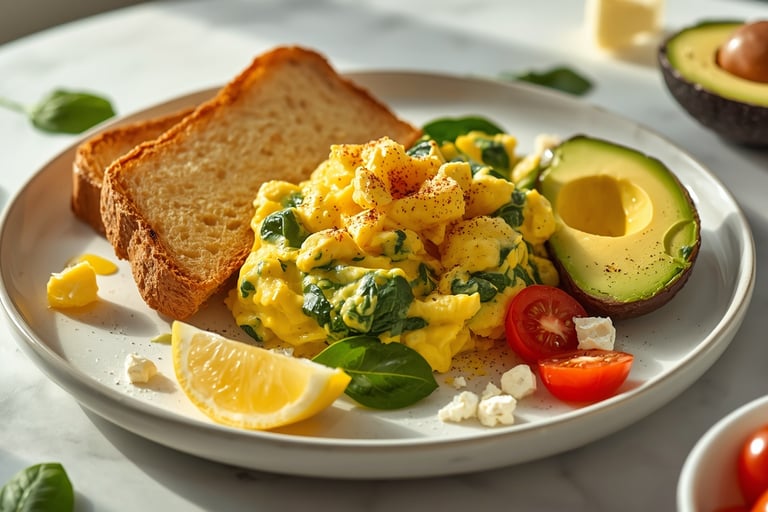
2. Scrambled Eggs With Spinach, Avocado, and Sourdough Toast
This is the classic combination that earns its reputation. Two eggs scrambled with wilted spinach on a slice of genuine sourdough toast, alongside half an avocado — providing 28g of protein, 9g of fibre, and the choline, lutein, magnesium, and potassium that make this one of the most micronutrient-complete breakfasts available.
Why it supports your health: Eggs provide choline for acetylcholine production (cognitive function and memory), lutein and zeaxanthin for eye protection, and complete protein with all nine essential amino acids. Spinach wilted into the eggs adds 80mg of magnesium per large handful alongside iron and calcium. Sourdough toast — unlike standard bread — has had its phytic acid dramatically reduced by fermentation, making its minerals significantly more bioavailable. Avocado's OEA (oleoylethanolamide) activates satiety signalling through the vagus nerve — producing 28% greater satisfaction at 3 hours post-meal in clinical research.
Ingredients (serves 1):
2 large eggs
1 large handful baby spinach
½ ripe avocado
1 slice genuine sourdough bread
1 tablespoon butter or olive oil
Salt, pepper, and optional chilli flakes
Lemon juice (a squeeze over the avocado)
Optional: cherry tomatoes, feta crumbles
How to make it:
Toast the sourdough. Meanwhile, heat butter or olive oil in a non-stick pan over medium-low heat
Add spinach and cook for 1 minute until just wilted. Season lightly
Whisk eggs with a pinch of salt. Add to the pan over the wilted spinach
Stir gently and slowly with a spatula — slow, low heat produces the creamiest scrambled eggs. Remove from heat just before they look fully set (they will continue cooking from residual heat)
Mash or slice the avocado. Season with salt, pepper, and lemon juice
Serve eggs on toast alongside the avocado
Preparation time: 8 minutes ~510 calories | 28g protein | 9g fibre | 32g healthy fat
3. Greek Yogurt Parfait With Berries, Granola, and Pumpkin Seeds
This is the breakfast that looks like a dessert, takes 3 minutes to assemble, and provides 24g of protein alongside the most diverse range of micronutrients of any recipe on this list. The combination of Greek yogurt probiotics, berry anthocyanins, and pumpkin seed magnesium makes this one of the most genuinely nourishing breakfasts available.
Why it supports your health: Plain full-fat Greek yogurt provides 17–20g of complete protein per cup alongside live Lactobacillus and Bifidobacterium cultures that support gut microbiome diversity. Blueberries provide anthocyanins that cross the blood-brain barrier and have documented neuroprotective activity — a randomised controlled trial confirmed significant memory improvement with regular blueberry consumption. Pumpkin seeds add 156mg of magnesium per 2 tablespoons (39% RDA) alongside zinc for immune function.
Ingredients (serves 1):
200g plain full-fat Greek yogurt
½ cup mixed fresh berries (blueberries, raspberries, strawberries)
3 tablespoons low-sugar granola
2 tablespoons pumpkin seeds
1 tablespoon honey or maple syrup
Optional: a sprinkle of hemp seeds, a drizzle of almond butter
How to make it:
Spoon Greek yogurt into a bowl or wide glass
Layer granola over the yogurt
Arrange fresh berries across the top
Scatter pumpkin seeds and hemp seeds if using
Drizzle with honey
Add almond butter if using — it makes the parfait more filling and adds healthy fat
Preparation time: 3 minutes ~420 calories | 24g protein | 5g fibre | 16g healthy fat
4. Smashed Avocado With Poached Eggs and Sourdough
The brunch classic that earns its place as an everyday breakfast. Two poached eggs on sourdough with smashed avocado, chilli flakes, and lemon — providing 26g of protein and the aesthetic satisfaction of a café-quality meal made at home in 10 minutes.
Why it supports your health: Poaching is the cooking method that preserves the most nutritional integrity of the egg — no additional fat required, lower heat than frying, and the protein and choline content is fully preserved. The sourdough fermentation dramatically reduces phytic acid compared to standard bread — improving the bioavailability of its magnesium, zinc, and iron. Avocado's oleic acid enhances the absorption of the lutein and zeaxanthin from the egg yolk alongside it — the fat-soluble carotenoids absorb more efficiently with the monounsaturated fat from the avocado present.
Ingredients (serves 1):
2 large eggs
1 ripe avocado
1–2 slices genuine sourdough
Juice of ½ lemon
Chilli flakes and sea salt
1 tablespoon white wine vinegar (for poaching)
Optional: baby spinach leaves, cherry tomatoes, everything bagel seasoning
How to make it:
Toast the sourdough. Halve and pit the avocado, scoop into a bowl with lemon juice, salt, and chilli flakes. Smash roughly — keep some texture
Bring a small saucepan of water to a gentle simmer. Add the white wine vinegar
Create a gentle swirl in the water with a spoon. Crack each egg into a small cup and slide gently into the swirling water
Poach for 3–4 minutes until the whites are fully set but the yolk is still runny
Remove with a slotted spoon and rest briefly on kitchen paper to absorb excess water
Spread smashed avocado generously on the toast
Top with poached eggs, a final pinch of sea salt, chilli flakes, and a squeeze of lemon
Preparation time: 10 minutes ~520 calories | 26g protein | 10g fibre | 34g healthy fat
5. Banana Oat Protein Pancakes
These are genuinely one of the most satisfying breakfasts on this list — soft, slightly cakey pancakes made from oats, banana, eggs, and Greek yogurt with no white flour and no refined sugar. They take 15 minutes from start to finish and consistently surprise people with how genuinely pancake-like they are despite their whole food base.
Why it supports your health: Oats provide beta-glucan fibre alongside the complex carbohydrates that support sustained morning energy. Banana provides potassium and vitamin B6 for serotonin and dopamine synthesis — supporting the mood-stabilising neurotransmitter production that makes mornings feel genuinely manageable. The eggs provide complete protein and choline. Greek yogurt in the batter adds protein and keeps the pancakes moist.
Ingredients (serves 1–2 — makes approximately 6 small pancakes):
1 ripe banana, mashed
2 large eggs
½ cup rolled oats (or oat flour — blend oats to flour)
½ cup plain Greek yogurt
1 teaspoon baking powder
½ teaspoon cinnamon
1 teaspoon vanilla extract
Pinch of sea salt
Coconut oil or butter for cooking
Toppings:
Fresh berries, a drizzle of honey, Greek yogurt, or almond butter
How to make it:
Mash the banana thoroughly in a large bowl
Add eggs, Greek yogurt, and vanilla extract. Mix well
Blend oats to a coarse flour or use oat flour directly
Add oat flour, baking powder, cinnamon, and salt to the wet ingredients. Stir until just combined — a few lumps are fine, do not overmix
Heat a non-stick pan over medium heat with a small amount of coconut oil or butter
Pour approximately 3 tablespoons of batter per pancake. Cook for 2–3 minutes until bubbles appear across the surface and the edges look set
Flip carefully and cook for 1–2 minutes more until golden
Serve with fresh berries and a drizzle of honey
Preparation time: 15 minutes ~440 calories | 24g protein | 6g fibre | 14g healthy fat
6. Chia Seed Pudding With Mango and Coconut
Chia pudding is the overnight breakfast that requires the least morning effort — made entirely the evening before, it sits in the fridge and is ready to eat with fresh toppings in the morning. The tropical mango and coconut version is the most visually stunning and the most summery.
Why it supports your health: Chia seeds provide 9.8g of dietary fibre and 4.9g of ALA omega-3 per 2 tablespoons — the mucilage hydrogel that forms overnight moderates morning blood glucose and provides sustained physical fullness. Coconut milk provides MCTs (medium-chain triglycerides) metabolised directly to energy rather than stored. Mango provides beta-carotene and vitamin C. The Forever Lite Ultra® vanilla protein powder (optional addition) takes this from a fibre-rich breakfast to a 25g+ protein meal that covers both the satiety hormone threshold and the omega-3 and fibre benefits simultaneously.
Ingredients (serves 1):
3 tablespoons chia seeds
½ cup light coconut milk
½ cup unsweetened almond milk
1 tablespoon maple syrup
½ teaspoon vanilla extract
Toppings:
½ cup fresh mango, diced
2 tablespoons toasted coconut flakes
1 tablespoon macadamia nuts or cashews
Juice and zest of ½ lime
How to make it:
Combine chia seeds, coconut milk, almond milk, maple syrup, and vanilla in a jar or container
Stir immediately for 30 seconds. Stir again after 5 minutes to prevent clumping
Cover and refrigerate overnight (minimum 4 hours)
In the morning: top with diced mango, toasted coconut flakes, macadamia nuts, and lime zest
Squeeze lime juice over the top just before eating
Preparation time: 5 minutes (the night before) ~360 calories | 10g protein | 14g fibre | 18g healthy fat
7. Turmeric Scrambled Eggs With Sourdough and Greens
This is the everyday eggs recipe that adds anti-inflammatory benefit to the most classic breakfast available. Turmeric in scrambled eggs produces a vivid golden-yellow colour alongside the curcumin NF-kB inhibitory activity — always with black pepper to activate the 2,000% curcumin absorption increase from piperine.
Why it supports your health: Turmeric curcumin directly inhibits NF-kB — the master inflammatory transcription factor. Black pepper piperine increases curcumin absorption by up to 2,000% — without it, the curcumin from turmeric is largely eliminated before reaching circulation. Two eggs provide 294mg of choline (55% of the daily adequate intake), making this breakfast the single most effective dietary strategy for supporting morning cognitive function through acetylcholine production.
Ingredients (serves 1):
3 large eggs
1 large handful baby spinach or kale
1 slice sourdough toast
1 tablespoon butter or olive oil
¼ teaspoon ground turmeric
¼ teaspoon black pepper (essential — activates turmeric)
Salt to taste
Optional: cherry tomatoes, feta, fresh herbs
How to make it:
Whisk eggs with turmeric, black pepper, and a pinch of salt until the turmeric is fully incorporated — the eggs will turn vivid golden yellow
Heat butter or olive oil in a pan over medium-low heat
Add spinach or kale and wilt briefly for 30 seconds
Add the turmeric egg mixture. Stir slowly and gently with a spatula over low heat
Remove from heat just before fully set — residual heat finishes the cooking
Serve over sourdough toast. Add cherry tomatoes and feta if using
Preparation time: 8 minutes ~430 calories | 28g protein | 4g fibre | 22g healthy fat
8. Smoothie Bowl With Protein and Toppings
A smoothie bowl takes the liquid nutrition of a smoothie and slows it down — the act of chewing toppings activates digestive enzymes and satiety signals more effectively than drinking the same nutrients in liquid form. This version uses spinach, banana, and mixed berries as the base alongside Greek yogurt for protein.
Why it supports your health: The spinach in the smoothie base contributes iron and magnesium in a format that most people find easy to consume — the berry flavour completely masks any spinach taste. Frozen banana provides the thick, ice-cream-like consistency that makes smoothie bowls genuinely satisfying. Greek yogurt provides protein and probiotics. The toppings — granola, seeds, fresh fruit — add texture and the chewing that makes the breakfast more satisfying and more effective at activating satiety signals.
Ingredients (serves 1):
Smoothie base:
1 frozen banana
1 cup frozen mixed berries
2 large handfuls baby spinach
200g plain full-fat Greek yogurt
2–3 tablespoons almond milk (just enough to blend)
Toppings:
3 tablespoons granola
2 tablespoons pumpkin seeds
½ cup fresh berries
1 tablespoon almond butter
A drizzle of honey
How to make it:
Add frozen banana, frozen berries, spinach, Greek yogurt, and almond milk to a high-speed blender
Blend on high until completely smooth — the consistency should be very thick, like soft serve ice cream. Add almond milk one tablespoon at a time only if needed
Pour into a wide bowl (not a glass — the bowl format is essential for the topping experience)
Arrange toppings in sections: granola on one side, fresh berries on another, almond butter drizzled across
Scatter pumpkin seeds over the surface
Eat with a spoon
Preparation time: 5 minutes ~500 calories | 26g protein | 10g fibre | 16g healthy fat
9. Bircher Muesli With Apple, Walnuts, and Cinnamon
Bircher muesli — the original overnight oat dish developed by Swiss physician Maximilian Bircher-Brenner in the early 1900s — is one of the most genuinely satisfying cold breakfasts available. This version uses grated apple, walnuts, and cinnamon alongside oats soaked in apple juice and Greek yogurt.
Why it supports your health: Apples provide pectin — a soluble fibre that is particularly effective at feeding Akkermansia muciniphila, the gut bacterium most consistently associated with healthy weight regulation and lower systemic inflammation. The vitamin C in fresh apple juice aids iron absorption from the oats. Walnuts provide ALA omega-3 alongside ellagitannins that gut bacteria convert to urolithin A — a compound that stimulates mitophagy, the cellular clearance of damaged mitochondria. Cinnamon reduces postprandial blood glucose through inhibition of starch-digesting enzymes.
Ingredients (serves 2):
1 cup rolled oats
½ cup apple juice (fresh if possible)
½ cup plain full-fat Greek yogurt
1 large apple, grated (skin on — most pectin is just under the skin)
Juice of ½ lemon (prevents browning)
1 teaspoon cinnamon
1 tablespoon honey
3 tablespoons walnuts, roughly chopped
Optional: raisins, mixed seeds, grated nutmeg
How to make it:
Combine oats, apple juice, and Greek yogurt in a bowl or container. Stir well and refrigerate overnight
In the morning: grate the apple directly into the oat mixture (the lemon juice prevents browning — squeeze lemon over the apple as you grate)
Add cinnamon, honey, and half the walnuts. Stir to combine
Divide between two bowls if making for two
Top with remaining walnuts and any additional toppings
Preparation time: 5 minutes (the night before) + 5 minutes (in the morning) ~420 calories per serving | 18g protein | 7g fibre | 14g healthy fat
10. Salmon and Avocado Breakfast Bowl With Brown Rice
This is the most substantial breakfast on the list — and the most unusual for Western breakfast habits. But the smoked salmon, avocado, and brown rice breakfast bowl is genuinely one of the most nutritionally complete morning meals available. In Japan, fish and rice for breakfast is entirely conventional, and the nutritional case for starting the day with omega-3, complete protein, and complex carbohydrates is compelling.
Why it supports your health: Wild smoked salmon provides EPA and DHA omega-3 that directly reduce the prostaglandin-driven inflammatory signalling that accumulates overnight. It provides 25g of complete protein — the highest protein content of any recipe on this list — alongside vitamin D, selenium, and astaxanthin. Avocado's OEA satiety mechanism produces genuine fullness that extends through the morning. Brown rice provides complex carbohydrates at GI 50, releasing energy slowly rather than producing a blood glucose spike.
Ingredients (serves 1):
100g smoked salmon or tinned wild salmon
½ cup cooked brown rice (cook the evening before)
½ avocado, sliced
1 soft-boiled egg (optional — adds further protein)
½ cucumber, sliced
1 tablespoon soy sauce or tamari
1 teaspoon sesame oil
½ teaspoon sesame seeds
Spring onion, sliced
Optional: pickled ginger, nori strips, chilli sauce
How to make it:
If using pre-cooked brown rice from the fridge, warm briefly in a pan or microwave
Arrange rice in a bowl as the base
Place salmon on one side of the bowl. Arrange avocado slices, cucumber, and egg (if using) in sections around the rice
Drizzle soy sauce and sesame oil over everything
Scatter sesame seeds and spring onion
Add pickled ginger, nori, or chilli sauce if desired
Preparation time: 5 minutes (with pre-cooked rice) ~550 calories | 35g protein | 6g fibre | 28g healthy fat
Building a Healthy Breakfast Habit — The Weekly System
The single biggest barrier to a genuinely healthy breakfast every day is not knowledge or motivation — it is the absence of anything ready to eat at 7am when you are tired and pressed for time. The solution is building the habit around preparation rather than morning effort.
Sunday prep (30 minutes) that covers the week:
⏱️ 10 minutes: Make 3–4 jars of overnight oats (Recipe 1) — breakfast ready for Monday, Tuesday, and Wednesday
⏱️ 5 minutes: Make 2 jars of chia pudding (Recipe 6) — breakfast ready for Thursday and Friday
⏱️ 5 minutes: Cook a cup of brown rice for the salmon bowl (Recipe 10) — refrigerates 4 days
⏱️ 5 minutes: Prepare toppings — wash and portion berries, toast and cool granola, portion pumpkin seeds into small containers
⏱️ 5 minutes: Soft-boil 4–6 eggs — store refrigerated unpeeled for 5 days
The result: Five genuinely nourishing breakfasts prepared with 10–30 minutes of active Sunday evening effort. Monday through Friday, breakfast requires 3–5 minutes of morning assembly. The most common reason healthy breakfasts fail is that 7am is the wrong time to make the decision — Sunday evening is the right time.
Frequently Asked Questions
Is it better to eat breakfast immediately after waking up?
Research on breakfast timing is nuanced. For most people, eating within 1–2 hours of waking supports circadian rhythm alignment of metabolism and reduces the likelihood of overeating at lunch. People who exercise fasted in the morning may find that post-exercise breakfast timing works better for them. The most important variable is not the exact timing but the quality and composition of the breakfast when it is eaten — a high-protein, high-fibre breakfast eaten at 9am is significantly better than a high-refined-carbohydrate breakfast eaten immediately upon waking.
Is coffee a healthy addition to these breakfasts?
Black coffee alongside a nutritious breakfast is not problematic for most healthy adults — it provides antioxidant polyphenols alongside caffeine for alertness. The caution is with coffee replacing breakfast (delaying food intake with caffeine amplifies cortisol and can worsen blood sugar instability later in the morning) or with heavily sweetened and milk-laden coffee drinks that add significant sugar and saturated fat to an otherwise nutritious breakfast.
Can I eat these breakfasts if I am trying to lose weight?
All ten breakfasts on this list are designed around the same nutritional principles — adequate protein, fibre, and healthy fat — that research most consistently identifies as supportive of healthy weight management. High protein intake at breakfast reduces total daily calorie intake in most people through satiety hormone activation. The specific calorie counts (360–550 per serving) are appropriate for most adults within a balanced daily intake. Individual needs vary — a registered dietitian can provide personalised guidance for specific weight management goals.
References and Further Reading
Leidy HJ et al. — American Journal of Clinical Nutrition (2013) — Beneficial effects of a higher-protein breakfast on the appetitive, hormonal, and neural signals controlling energy intake regulation in overweight/obese, "breakfast-skipping," late-adolescent girls Research confirming that a high-protein breakfast significantly reduced daily calorie intake, reduced ghrelin, and improved appetite control compared to a low-protein breakfast.
Thies F et al. — NIH/PubMed (2012) — Oats and CVD risk markers: a systematic literature review Systematic review confirming that oat beta-glucan consumption is associated with significant reductions in LDL cholesterol and improved postprandial blood glucose response.
Krikorian R et al. — Journal of Nutrition (2010) — Blueberry Supplementation Improves Memory in Older Adults Randomised controlled trial confirming that blueberry anthocyanins significantly improved memory and cognitive function — supporting their inclusion as a regular breakfast addition.
Dreher ML and Davenport AJ — Critical Reviews in Food Science and Nutrition (2013) — Hass Avocado Composition and Potential Health Effects Review confirming avocado OEA satiety signalling and the fat-soluble nutrient absorption enhancement effect — establishing avocado as one of the highest nutritional value breakfast additions available.
About the Author
I'm Judith, a wellness enthusiast and Applied Bio Sciences and Biotechnology graduate behind BiteBrightly. With a deep-rooted belief in the healing power of food, my nutrition journey began with a personal transformation — I improved my eyesight through targeted dietary changes. This life-changing experience sparked my mission to empower others by sharing evidence-based insights into food as medicine.
Follow me on Pinterest for daily health tips, recipes, and morning meal inspiration.
Important Notice: The information and recipes in this article are for educational purposes only and are not intended as medical advice. I am not a medical doctor or registered dietitian. Individual nutritional needs vary based on age, health status, activity level, and personal circumstances. People with specific health conditions, food allergies, or dietary restrictions should consult a qualified healthcare provider or registered dietitian before making significant dietary changes. These statements have not been evaluated by the FDA.
Related Posts
Connect
Join our newsletter for fresh health tips
© 2026. All rights reserved.